We have received via email a quiet rough, preliminary and unofficial translation of the very document we published earlier. A final correction ist pending.
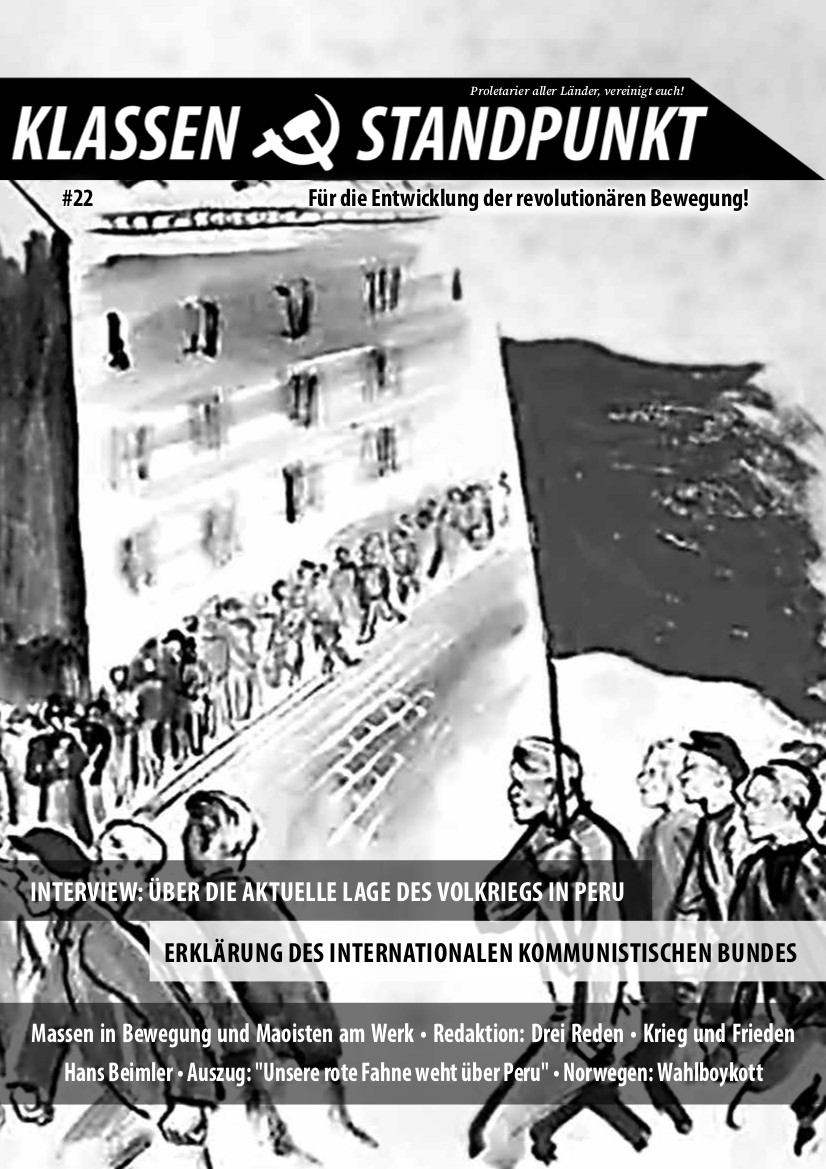
We have received word from the editorial staff of Klassenstandpunkt that the new issue is currently in print. Our comrades have sent us the following text for advance publication:
Preface
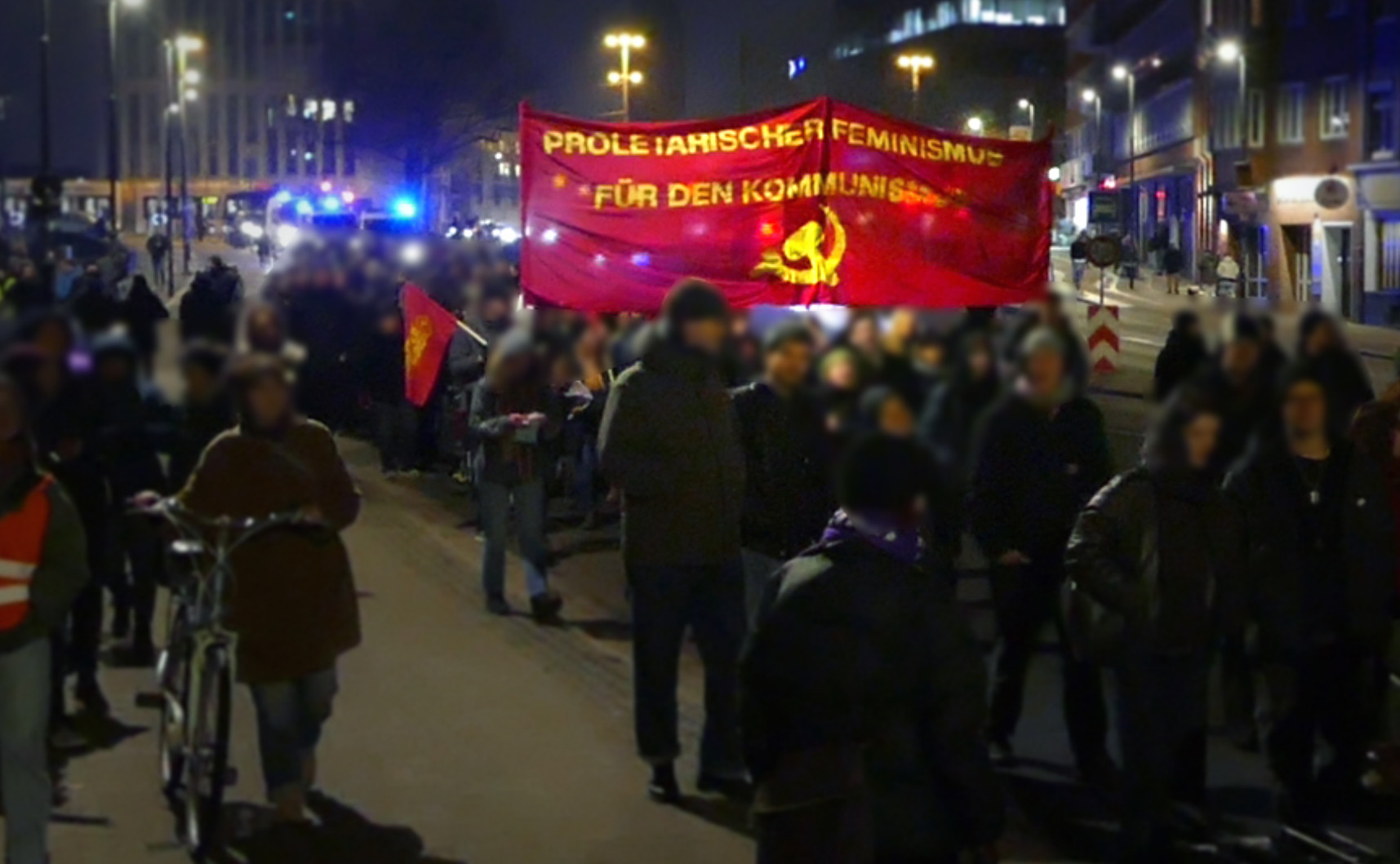
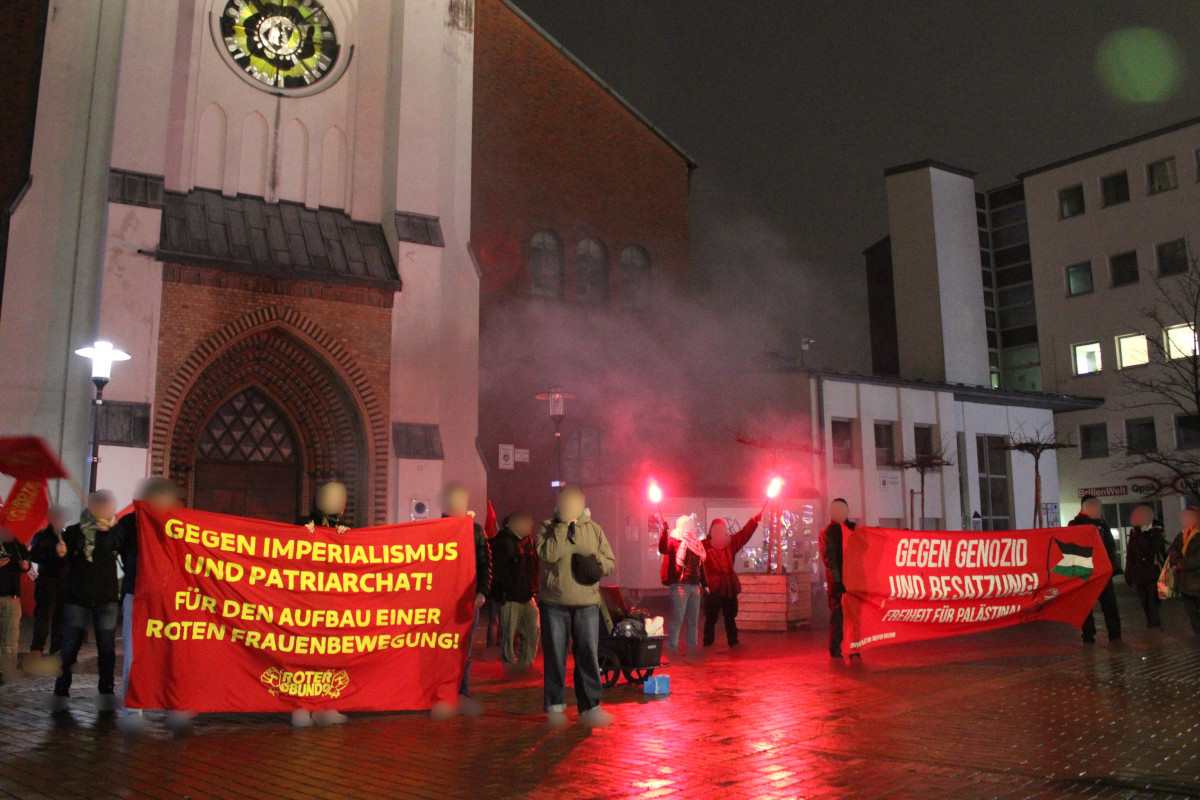
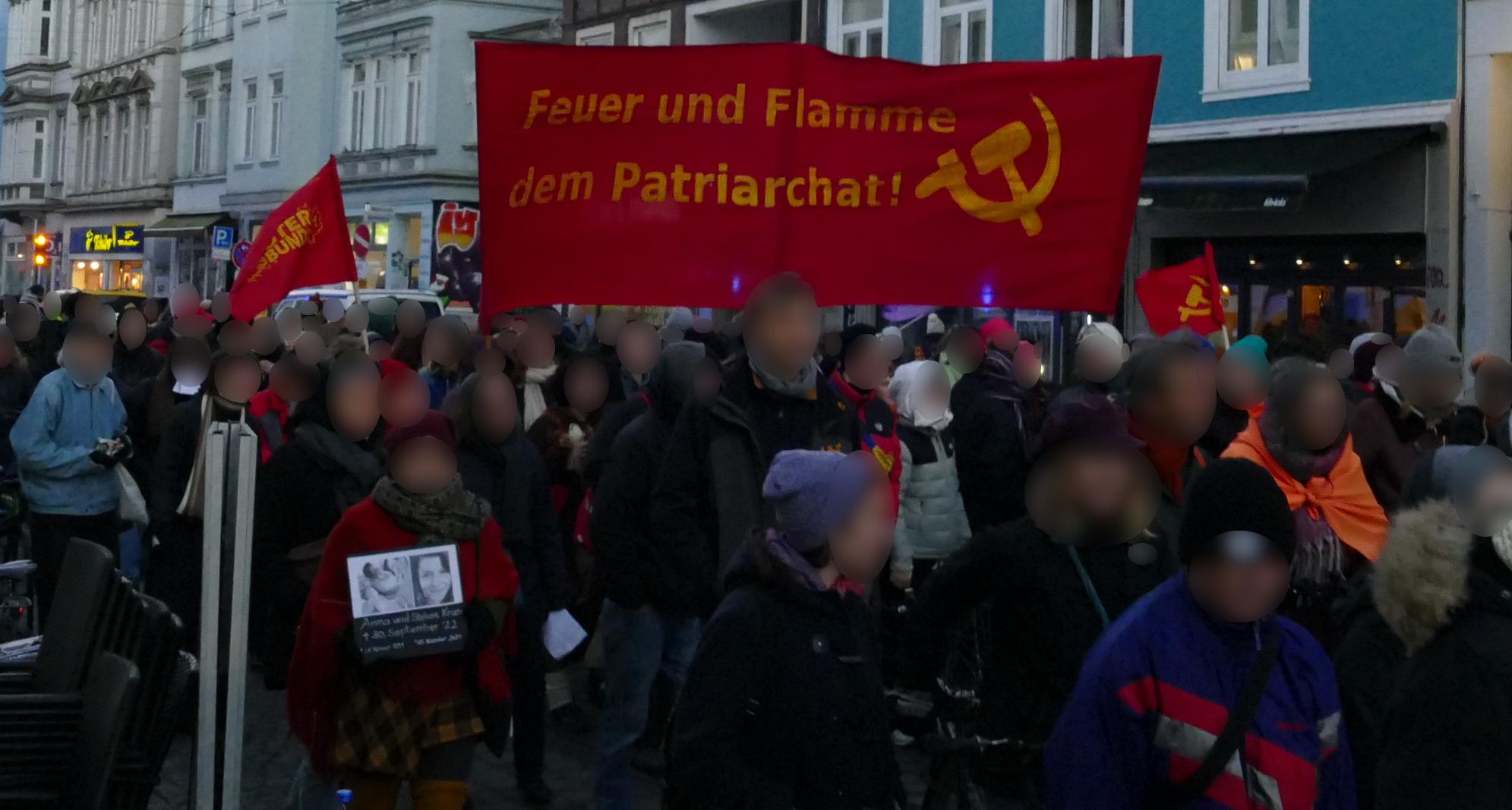
The following article Interview on some historical aspects of the People's War in Peru and its current situation is an edited version for the publication of an interview which a member of our editorial board gave to comrades who are involved in the mass work of the revolutionary activist organization Red League (German: „Roter Bund“, RB).
The context of why this interview took place, is that the comrades of the Red League, when they were talking to people which are interested in Maoism, especially those in the revolutionary and anti-imperialist movement and the topics of the relevance of Chairman Gonzalo1, the Communist Party of Peru (PCP) and the People's War in Peru were raised, for the last years they were confronted with statements and “arguments” such as “the People's War in Peru ended in defeat” and concluding “Why should we take a defeated party as a model?” and similar things that follow the same logic.This situation became especially difficult to handle for young comrades when they were met with people who had detailed knowledge on the situation in Peru and raised questions to which the comrades couldn’t find answers in the published documents of the comrades who support the the PCP in general and neither, which is especially problematic, in documents of the party itself and its associated organs. For that reason the comrades, on their search for answers reached out to us with the goal of obtaining the necessary arguments in order to be able to reject false claims and make a powerful defence of Chairman Gonzalo, the PCP and the People's War. Facing this situation we increased our efforts – have been making requests like these for years - to request international comrades whom we deem to be more qualified than ourselves to talk about the situation in Peru and especially the Peruvian comrades with whom we have been working together for as long as we’ve been publishing this magazine on that matter. However neither documents nor articles were published which presented the situation of the PCP and the People's War clearly and comprehensively for the comrades in Germany, no matter how strongly we insisted on it. Through that we understood that in order to arm those who have decided to uphold defend and apply the contributions of Chairman Gonzalo, which is Gonzalo-Thought, in their struggle against all forms of revisionism, opportunism and wrong ideas in general we had to take this matter into our own hands. So we complied with the request of the comrades of the Red League after we had discussed this issue extensively for some time within our editorial board.
The comrades of the RB had collected questions from members from different parts of the country and afterwards put together a list of the most fundamental questions which had to be answered for them. This list was then worked through in the interview. After the interview was put into writing adequately it was circulated in the several apparatuses of the Red League for deep collective study and discussion. Also comrades from other parts of the Maoist movement in Germany were invited to participate in this. This process went on until roughly summer this year. After the comrades of the RB had reached a generally united understanding, in September this year, on the occasion of the anniversary of the speech of Chairman Gonzalo2, one year after the interview took place, public events were organized in which it was presented and where interested comrades , who aren’t organized in the Maoist movement, could participate in the discussion and obtain a clear picture of the situation of the PCP, the People's War and its influence on the struggle in Germany and its perspectives. Now we present this interview to the revolutionary and anti-imperialist movement in general because we are convinced that it will serve to strengthen the left within and disarm those who strive to take advantage of the complex and difficult situation in which the heroic comrades in Peru find themselves, who despite of all the difficulties never lowered the reddest flag of Chairman Gonzalo, the PCP and the People's War. We asked the comrades of the Association New Democracy in Hamburg (“Verein Neue Demokratie in Hamburg”), comrades who have led the solidarity with the People's War in Peru in this country over decades, for their consent to do this and received it.
To such comrades and friends who might not understand our procedure on that matter we recommend to remember the words of Chairman Mao Tse-Tung: “Communists should set an example in being practical as well as far-sighted. For only by being practical can they fulfill the appointed tasks, and only far-sightedness can prevent them from losing their bearings in the march forward.”3
We are fully convinced that a clear and realistic view on the situation in Peru bears no reason for pessimism, but rather is essential to overcome the difficulties. No temporary defeat, no temporary setback can stop the way of history and the People's War will inevitably triumph. As Chairman Gonzalo said it himself: “…I think, I am quite optimistic, this is because of Marxism; it is Chairman Mao, who has made us understand that us people, especially us communists, are optimists. Whenever I find myself in a difficult situation I strive to look for its positive aspect or for what potential for development may still exist within that situation, because nothing ever is completely black, nor is anything ever completely red. Even if there were to be a big defeat, even though we have not had one yet, there would always be a positive aspect; the point is to draw out the lessons and to continue to do our work based on that basis; one will always find someone to support you, to lend their ardent enthusiasm and assistance to the struggle, because communism unites.”4
In this spirit we prepared the following document.
Interview on some historical aspects of the People's War in Peru and its current situation
September 24th 2024
Roter Bund (RB):
I welcome the comrade of the editorial board of Klassenstandpunkt (KSP) on the topic of “People's War in Peru – today”, what developments there are, where we are on the matter of reorganization and also on historical questions of the People's War in Peru
Klassenstandpunkt (KSP):
Thank you comrades for the opportunity to talk to you today. We think its very symbolic to do this interview today on the on the 24th of September. It has been 32 years today since Chairman Gonzalo delivered his famous speech; A thing that we have celebrated over the years and that is celebrated in the Red League each year – as far as we know. The significance of this speech is summarized in the definition by the Central Committee (CC) of the Communist Party of Peru (PCP) on the fifth anniversary of the speech. The definition is: “The speech of Chairman Gonzalo is shining victoriously and powerfully before the world as a weapon of combat”5 This is the correct definition of the speech and therefore the name one should call it.
Over the years there were mainly two other terms that the speech was named. One came out of the rows of the RCP-USA (Revolutionary Communist Party of the USA; the party of Avakian) and the CoRIM (Committee of the Revolutionary Internationalist Movement): “The speech from the cage”, which meant to put into the spotlight exactly that which the reaction wanted to achieve with the show of Chairman Gonzalo being taken as a prisoner of war. The fact that Chairman Gonzalo shattered this “show” with an extremely remarkable and communist stance only becomes a secondary matter when one focuses on the incarceration.
The second wrong term and therefore the third, better known name comes from the Second Right-Opportunist-Line which we will discuss later on several times: “The masterful speech of Chairman Gonzalo in the historical condition of his imprisonment” which also focuses on the imprisonment as such. It focuses on the strike which the CC, the party, the Peruvian revolution and also world revolution was dealt with the war-captivity of Chairman Gonzalo.
But when we look at the speech it is in essence a conclusion and precision of the resolutions of the third plenum of the Central Committee which took place exactly in the period in which Chairman Gonzalo was captured. This is what Chairman Gonzalo underlines in the speech, too: That the task for every member of PCP, all combatants of the People’s Guerrilla Army or the People’s Liberation Army, all organized Masses and the people in general and also of course all revolutionaries of the world, who supported the Peruvian revolution is to fight to fulfill the resolutions of the third plenum. This includes the forth strategic construction plan and also the great military plan “Construct the conquest of Power all over the country”. If one were to simplify this a bit, all of the problems that occurred in the People's War are consequences of not applying these decisions.
In addition we can see the immense foresight of Chairman Gonzalo. Concerning the question of the understanding of the proletarian world revolution and as Chairman Gonzalo rightly said “Maoism embodies itself in the peoples of the world”6 and how Maoism creates new communist parties. A process that evolved with different advances and setbacks and was generally delayed by the imprisonment of Chairman Gonzalo as a prisoner of war and the consequences this had. But this process of the embodiment of Maoism can be felt intensely today with the International Communist League (ICL) as a peak in a period in the struggle for Maoism.
In this sense, today is a very well chosen date, a beautiful opportunity and it sets the frame for the work we have to develop.
When we begin with the specific topic, the situation of the People's War today, what the situation of the PCP is, we believe the first thing which we need to start with is to define why this topic is so important in the first place. For us this is above all a question concerning the understanding of the significance of Chairman Gonzalo, the PCP and the People's War as a historic contribution to the development of ideology, the ideology of the international proletariat that is Marxism-Leninism-Maoism, principally Maoism with the contributions of Chairman Gonzalo that is Gonzalo-Thought. It is principally the definition of Maoism that we put in the spotlight above all of the teachings that developed from his application on Peruvian reality, all the contributions and developments by Chairman Gonzalo.. There are many practical experiences, many unbelievable expressions of heroism from the deepest masses to the comrades in the shining trenches of combat, the prisons, the struggle of political prisoners and revolutionary prisoners of war and so forth. But this is not what has to be principal for us as communists in formation. This means when we talk about Chairman Gonzalo, about the PCP and about the revolution in Peru, the People's War, the decisive aspect is not its situation today but its historical significance and here mainly what it means for the development of our ideology.
This is something that is diametrically opposed to two positions, two criteria, two standards that revisionism and opportunism always puts forward:
Revisionism always tries to claim with extreme empiricism that what is successful is what is right. That is something that we saw with Khrushchev-revisionism; of course one could send rockets to space , could conquer space and had an “unbelievable” leap in the development of productive forces in the Soviet Union and therefore the way to further this process was in an incredibly arrogant way “the only right one”. Another expression of that same criteria is the world-famous claim from Deng Hsiao-Ping “it doesn't matter if a cat is black or white, if it catches mice it's a good cat”7.
The consequence of that would also be, that if we followed those who are the “most successful”, then we would have needed to follow the FARC in Columbia in certain moments of history, we could have followed the PKK or we could have followed many, many other forces. But our interest when we want to assess something is not only its power and force but what it serves, in which function it works. Does it serve the goals of the proletariat, does it serve the struggle for communism? This is the decisive point. Going from that we see what is successful and what is unsuccessful.
The second criteria, which the revisionists have is widespread, also in Germany in the revolutionarist movement. Let’s take a look for example at the revisionists who in their documents try to state that the mistakes that occurred in the construction of socialism and in the revolutionary processes of communist parties, the Communist Internationale and so forth were consequences of the application of Marxism which means when Marxism was applied falsely then difficulties arose that in the end led to capitalist restoration or to the degeneration of communist parties.This is the same argument that Avakian puts forward and a very widespread position. One problem here is essential: They forget about class struggle. Revisionism is not the result of a wrongly applied Marxism or of “mistakes of Marxism” but revisionism is the ideological echo of the bourgeoisie within the ranks of the proletariat which means it exists as a hostile current to Marxism as an antagonist to Marxism.8
If we take these two points, regarding the question of the People's War in Peru, the contributions of Chairman Gonzalo and the PCP, into account, we have to therefore see what Chairman Gonzalo gave us, what serves our struggle in the interest of the proletariat,the proletarian world revolution and communism. This is the most important point we have to take into account. Then we have to take into account how these things took place in practice. Here we can’t say that the problems, the mistakes that occurred in the party are to be found within Gonzalo-Thought, within Marxism but the are mistakes are t be found in the influence of revisionism. Of course everyone makes mistakes and there are mistakes in the application and there were certainly comrades, apparatuses and sometimes even the party as a whole that made wrong resolutions and wrong decisions . This is normal. Everything else would be metaphysics. But this doesn’t mean that these mistakes are revisionism. The revisionist make revisionist mistakes. The echo and convergence that occur within the party are an expression of class struggle. They are the resemblance of class struggle within the party. The mistake is not within Marxism itself. Considering these two aspects allows us to make right assessments.
Lets look at the historical significance of the People's War in Peru. We believe, even though every example and comparison has its problems and there are always particularities, there are two milestones in the development of proletarian world revolution which ended in a defeat. There is the Paris Commune and the “dress rehearsal” of the revolution in Russia, the revolution of 1905. Even though they were both crushed and ended in defeat, both events brought forth results; political and military results of far reaching historical significance, contributions to the development of Marxism whose significance can’t be overstated. In case of the Paris Commune for example the question of the dictatorship of the proletariat is clarified very distinctly i. e. how the dictatorship of the proletariat is concretized9. Connected to this question, the development of Marxism, we should also acknowledge that in the revolution of 1905 the form of revolution was born in which this dictatorship concretized itself – with the process of development of the socialist revolution (at that moment a democratic revolution, but also later on with the October-Revolution 1917 continued as a socialist revolution), with the form of organizing the worker-peasant-alliance under the leadership of the party – through the Soviets10. There is an enormous amount of other developments of Marxism, of its understanding that come from this experience and and with the utilization of its conclusions and the principles that were established then the revolution of Russia could succeed, the Soviet Union could be constructed and then later on the revolution could succeed in China and be developed across other countries.
Just because a process experiences a temporary defeat, this tells us nothing about its significance. For us as a class, our defeats are always temporary because our victory is certain. Communism will establish itself. This means that every defeat we suffer as a class can only be temporary and relative. A definitive defeat of the proletariat would mean that the proletariat could no longer succeed in the end, that the proletariat could not arise once more, that communism could not come into existence. This would be a negation of our ideology, our scientific ideology, our whole worldview, that would be revisionism. Our defeats therefore are always temporary, fleeting. This is something that happens but never something that means our final defeat. So when the revolution in Peru is now in a very, very difficult position and the Peruvian revolution and therefore world revolution suffers this defeat – the People's War in Peru was a pioneer in a certain period in the International Communist Movement (ICM) and the defeat that the PCP suffered is a defeat of the Red Faction within the ICM – then none of these defeats or failures can be described as final. They are temporary and as pointed out the causes of these defeats are not caused by Marxism but by the echo and effect of revisionism. This shall be our introduction today on how to approach this issue.
We will return to the question of ideology and mainly which contributions Chairman Gonzalo has made and the principal contribution, the question of Maoism. But are there any questions to our explanations so far?
RB:
The central point has become clear: decisive is the contribution made by the People's War in Peru so far internationally. One can in fact see what Chairman Gonzalo said concerning the new parties and organizations that are forming everywhere. I simply chose one of the questions that we collected from our activists that follows from your explanations: “What effects did the People's War in Peru have on the international communist movement and in general in the world (of bourgeois politics)?”
KSP:
This question is of utmost importance and if we think about it, this also has to do with the way that Chairman Gonzalo conceptualized the People's War, how he applied Maoism to the concrete conditions in Peru under the existing objective conditions. Objective conditions, national and international. Not only the struggle between revolution and counterrevolution within one’s own country. As communists we always have to consider the process of world revolution, the struggle between revolution and counterrevolution on the world-level and the struggle of Marxism and revisionism on the world level. The coup in China, after the death of Chairman Mao – a short period, Chairman Mao dies in September and the coup takes place in October 1976 – has had an enormous effect in the ICM. The confusion that was caused by the spreading of the revisionist, Dengist “Three-World-Theory” and above all the advantage that the Hoxhaites and the Albanian revisionists could achieve from this was very big. This led to a wave of capitulations and spread immense pessimism. It is important to understand this problem: The death of Chairman Mao and mainly the coup that took place afterwards. The situation was different from that in the Soviet Union. There the left could preserve its power after the death of Lenin until 1956, in China it was different. This led to the world revolution losing its leadership, its principal base area in a very short time period. What had been the beacon for all communists and revolutionaries, the international proletariat and the peoples of the world was fundamentally lost from one day to the other. The period from 1976 to 1980 was a period of confusion, of ambiguity, of pessimism and of capitulations.
Maybe we should shed more light on this question in other moments: It wasn’t like armed struggles only took place in South-East Asia. There were attempts to develop armed struggle in Columbia according to the strategy of People's War. In many other countries the strategy of People's War was more and more accepted as well, with varying degrees of determination and success. But all of this was liquidated by revisionism in a very short period.
Chairman Gonzalo and the red faction around him are bringing the process of reconstitution of the party to its end and initiate the People's War. This way they take up the fallen flag and raise it again. This alone would be enough to prove the historical significance of the People's War in Peru. At that moment the revolution on the Philippines was in a severe crisis, Sison was in prison then and the Communist Party of the Philippines (CPPh) followed a line whose model was the sandinist revolution in Nicaragua. The Indian comrades were deeply divided – in this period there were only a few small working groups that started to develop the work in Bastar, Chhattisgarh etc., that would later become so powerful. There was very little to be seen. Just to mention two examples that are relevant today. This means that the initiation of People's War primarily meant to raise the flag again, to uphold the flag of communism in its highest form in the world again.
At first the echo was not very big, this, too, is something that is difficult to imagine for the younger comrades, that there was no internet then. Barely any ordinary person had access to a FAX-device so the transmission of messages throughout the world happened either through established contacts between parties, most of which were lost with the fall of socialist China – of course much of the coordination moved through that – or through the echo in the bourgeois media or other petty-bourgeois magazines and so on. The Peruvian reaction tried to suppress all information at the beginning of the initiation of People's War, the actions were reduced to the actions of cattle-thieves in the initial reports. They did everything to belittle especially the actions in the rural areas. The actions in the cities had some echo but were of course demonized by the revisionists and opportunists. It was claimed that the actions were terrorist attacks, that it was some extremists, sectarians etc. They tried to suppress it as much as they could. But with the development of People's War through more powerful actions it was no longer possible and after a few years, around 1982/83 the People's War became known on a global level. It became known primarily to the communists of the world who held fast to Marxism. A lot of them then came together in the Revolutionary Internationalist Movement (RIM) and the RIM then put the People's War in Peru on its banners. This was one of the positive aspects of the RIM, that is often denied, that the RIM indeed served massively in increasing the renown of the People's War in Peru, the PCP and Chairman Gonzalo. As it is stated in various documents of the RIM from that period: the People's War in Peru was a torch of hope for communists in the world. As stated before, this alone would be an achievement to warrant glory.
RB:
With the increasing renown of the People's War in Peru there were surely actions of solidarity, here I have two questions. Firstly, what kinds of actions in solidarity were there in other countries? Secondly, were there comrades from other countries who joined the struggle in Peru directly?
KSP:
When it comes to the solidarity-work in this sense, or rather the development of agitation- and propaganda-campaigns in support of the development of the Peruvian revolution, the People's War and the PCP the RIM played an important role. In the propaganda of the RIM be it in “A world to win”11 or various leaflets etc., the People's War was always present until the mid 1990s when the problems were antagonized completely. Additionally international support campaigns were developed within the framework of the RIM. The first international campaign was for the freedom of a member of the CC at that time, her nom de guerre was “Meche”12. In different countries where the RIM was active and also in other countries actions were developed. All those things can be found in the issues of “A world to win” which are online13. Of course this kind of work made huge leaps with the campaign in defense of the life of Chairman Gonzalo. But we think the comrades already know this, it is documented for example in “You must tell the world”14. What has to be added is the work developed by the PCP itself.
This work was organized with militants, who in case of this works leadership, belonged to the First Right-Opportunist-Line. People who were in one moment in fact against the initiation of People's War, but who criticized themselves and later reincorporated themselves in the work of the party and then started to fulfill tasks abroad. The most important work in this area took place in Sweden and France. This work was organized by the party, primarily because there were some capitulationists who wanted to build up their own “business” in a way and bargain with the prestige of the People's War and the name of the party. They presented themselves as representatives of the party, which they were not; o put an end to this and to develop the work abroad under centralized the PCP created the Peoples Movement of Peru, the „Movimiento Popular Peru“ (MPP), as a created organism for the party work abroad (according to exact instructions by Chairman Gonzalo). This organization then developed in various countries, there were structures in the United States, Mexico, Spain, France, Switzerland, Germany, for a short period in Belgium - there were always problem in Belgium but this is another story – in Denmark, Sweden, as well as work with contacts and comrades in other countries. All of this was work that was lead by the respective apparatuses abroad, under the leadership of the CC. This organization abroad still exists today and we work with the comrades and it is important work but it is much reduced in its quantity. But this work plays a decisive role primarily for the ideological struggle in the ICM and raises the flag of Chairman Gonzalo and the red faction up high. Those are the comrades – even though we have some criticism about them from time to time – who have truly deserved our utmost respect and our recognition. Here it is important to make something clear about the term “solidarity work”: We know the work being done for example by the CPPh, but by others too, where the work abroad exists exclusively in order to further the development of struggle in ones own country but not to take up an internationalist task of the international proletariat. Here once again we see the rock-solid class position of Chairman Gonzalo, his deep understanding of the revolution because the MPP has received three tasks:
1. To create public opinion for the support of the People's War.
2. To Support the struggle for the constitution or reconstitution of the Communist Parties.
3. To serve the proletarian world revolution and within it the RIM.
The tasks that the comrades of the work abroad of the PCP fulfilled, led to or at least provided a decisive contribution, so that we, especially in Europe today, have comrades who fight under the banner of Maoism for the constitution or reconstitution of communist parties at all. The significance of the work in countries like Sweden, Germany, France that these comrades did, following the instructions by Chairman Gonzalo can not and under no circumstances should be dismissed. Without the work done by the PCP, this work definitively wouldn’t be in the stage of development that we have right now. That is it in regards to the solidarity-actions. There’s as stated before, many details which can be found searching through the materials of the RIM.
Whether comrades from abroad, from other countries, fought in the People's War in Peru? Yes. Of course there are different cases, with varying levels of popularity. What has become known publicly is that comrades from other Latin-American countries, that is from Chile and Bolivia fought in Peru and gave their lives. But there were also Spanish comrades who fought in the People's War, at least one case is known. This comrade gave his live as a combatant of the revolutionary army. Yes, there were communists, internationalists from other countries who fought in the ranks of the Peoples Guerrilla Army.
RB:
Thank you for the answers. Now lets move on to the People's War itself. The central point of Maoism is the question of the conquest of power for the class through People's War which means the elemental aspect of People's War is the question of the new state. How did the party build the peoples committees concretely, how can one imagine that the peoples committees are clandestine in the areas where they are not fully developed?
KSP:
Firstly, to explain the manner in which we will answer this question it’s important to say that we have published two important articles on this topic in KSP. One deals with how the Second Right-Opportunist-Line came to be end developed the process of the reconstitution of the party up until the initiation of People's War, the other with the origin of the second right-opportunist-line, its development and what role it played. What is missing is the period of the People's Wars development itself. For quite a long time we have an unpublished issue of KSP dealing with the process from the initiation of the People's War until 1999. We will return later to why exactly this period. Whats is still missing is the period from 1999 until today and we believe this interview is part of the process to get this work done.
So there are documents that are prepared. Due to different problems, on which we don’t want to comment further, this work is temporarily suspended, the original version of the document is finished since the beginning of 2024 and we will, hopefully soon, be working on this matter with the Peruvian comrades.
The comrades who asked this question should look into the document “Our red flag is flying in Peru”15 that was published on DemVolkeDienen. This is a translation of a report of the CC of the PCP to the RIM which was then popularized as an article in “A world to win”. In it is described very clearly: the different commissars of the committee/of the party, their tasks, the question of the state-system, the question of the government-system and different types of peoples committees, meaning the six kinds of New Power etc. It is better that the comrades learn that themselves.
But we can explain a bit how new power can exist in clandestine forms. Because this is indeed quite important for the strategy on how we will have to develop People's War in this country and also we can repeat some things here. Let us analyze the experience of armed struggle in cities, or at least in urban areas, whether it is in the national liberation struggle such as in Ireland or in – which of course was also principally national liberation struggle – the partisan struggle of the antifascist resistance during World War II or other experiences such as in China or in the Soviet Union. The workers and the populous were organized before the insurgency. It is not like it was unorganized masses carried through the uprisings. Therefore this is a question were there is a rich experience and which is nothing new in itself. To simplify a bit, because some comrades stumble across the world “clandestine” because it is a technical term that one often struggles to contextualize; If we replace “clandestine” with “underground”- structures, we think, the idea becomes a little more clear.
The bodies of peoples power are at first smaller committees which are made up of the members of created bodies. Those are led - according to the concentric structure - by the army under the leadership of the party. This means the comrades meet in the neighborhoods and make decisions on what is to be done to fulfill the directives of the party. If the work grows, then of course one has to find ways on how to hold assemblies.
All comrades know that every meeting has some kind of cover. This means you need a cover-story, a place you can use etc. Just to show how easy this is: In most of the proletarian neighborhoods there is a football club, the club has a local in which the members meet and discuss different topics, there is nothing strange about this. This means if the club elects a new board, one can, in the framework of this assembly, elect under this cover, the leadership of a clandestine peoples committee, organized underground. This is no witchcraft, one only has to be somehow creative to find solutions to those questions and the necessity of war is what enables – or forces - us to find solutions. And how the masses are organized one can grasp easily: how do we organzine the masses? What can the masses provide?
If we talk about the neighborhoods, there is the best intelligence service world-wide. When you meet the grandmothers, who meet in front of the supermarket and talk about what is going on in the neighborhood, who is dating whom, who is jobless, who is how sic and who is doing something else etc. – they know everyone. The cashier in the supermarket knows in seconds wether someone is from the neighborhood or not and since when they live there etc. Children see all the strange guys who are lurking around in the neighborhood and can provide information about it. If we have a committee there, we can have extensive control in the from of an intelligence service in the neighborhood. This is how partisans and resistance-movements have always worked.
How can we organize defense? Firstly there is the information from our intelligence service, our channels of information, our scouts which keep the revolutionary army up to date. Then we have organized people in every house in every stairway. This means there are comrades who, in the case of an attack or if there are other tasks, can go outside and defend the neighborhood in an adequate manner according to the overall development of the revolution. We always meet in out peoples-committees, worker-committees, council meetings or however the name of the organs of new power will be, in the locale of the club.
The thing is we have to stop fantasizing about assault rifles, rocket launchers and parades and see how we can organize the people in a militarized way with simple means and without the militarized expressions, then it is not that hard.
Then one can see how we can build clandestine power. Of course there are specific conditions to the situation in Germany, where the state is much stronger and better organized than it ever was the case in Peru. This also means that the clandestine period will be a longer period which is mainly due to the urban character of the People's War that will be mainly urban guerrilla warfare with several complements, meaning several other forms of struggle in different places.
Regarding the specific structure of the different commissariats, the different kinds of functions in Peru, the comrades should, as said, look up “Our red flag is flying in Peru”.
RB:
I will now follow up with a question also in regard to the People's War: How were the physical-geographical conditions used to the favor of the guerrilla warfare? Maybe also with a perspective to Germany where the geographical conditions differ a lot from those in Peru.
KSP:
Of course it was a fact that it was fought in the mountains, in the highlands and in the jungles. In the highlands especially in Ayacucho, the southerner central region of Peru, there is also rain forest or rather Jungle and the favorable conditions from a purely military perspective are the areas where mountains and jungles meet, what is called “la Ceja de Selva”16.
An area in which a very powerful struggle was developed and base areas were build, was in the region of Huallaga, a part of the Amazon-rain-forest. Of course this played a role but the main point is that People's War is a war of the masses. This means in order to develop People's War, one has to develop it where the masses live.
In relatively few places the masses live concentrated in the rain-forest and when they live in the mountains, then not at the peak but on the highland-plateau. This is an important aspects for comrades who have difficulties to make the connection to Peru simply because they don’t know it: In the highlands the villages often lie very open, which means in high altitude and isolated, but in a level area where you cant just walk in unseen. Such areas are easy to monitor, so it is of course favorable for the guerrilla to control the heights, if it’s not the guerrilla but the reaction who does so, this becomes quiet a big problem. This means the geographical conditions in the highlands are not only favorable for the revolution but are dependent on where one is located and the relations of power.
The advantages were of course utilized but the core point still remains that the party has to be where the masses are. The masses make the People's War.
What mainly happened since 1999, when the CC got blown up: The militarists have consciously withdrawn as warlords, but in order to be where there are the most favorable geographic conditions for guerrilla warfare.
The militarists are mainly José and his followers, who today call themselves the “Militarized Communist Party of Peru” and they are responsible for the actions that we see in the news from time to time, for example when they killed 16 Lumps in a brothel during the last elections in Peru, which has gotten some attention also in Germany.
These people develop guerrilla warfare in the area “la Ceja,de Selva”. The core of this area is a province in the department Ayacucho, by the name of Vizcatan. Their guerrilla units move in an area from Apurimac, Huancavelica and Ayacucho and partly in an area of Cuzco, a province that is called La Convencion. This is the area of Peru that has the most favorable conditions for guerrilla warfare with the combination of mountains and rain-forest but the problem is, that there are relatively few villages so they invented something they call “mobile people-committees” which means they bring the masses with them. They take all the people with them what results in nomadic existence. This also shows that it is a militaristic deviation to focus on favorable geographical conditions and not on the questions of the masses.
So yes, one can and should make use of the geographical conditions and here in Germany it is one of the advantages of the revolution, where we can find big concentration of masses, this is an advantage. The thing is, that the big amount of mid-sized city’s can play an advantageous role. It is way to early to analyze this in Detail but this can be a very positive thing.
One thing that is very clear in many aspects is the question of rural areas. If we look at Niedersachsen (lower Saxony,One of the 16 federal states in Germany,) for example, we see that the villages are for the most part relatively reactionary strongholds, here the imperialist state will most likely be able to archive a lot of mobilization. When we take a look at the elections in eastern Germany, the AfD (right-wing party in Germany) has gotten a lot of votes from farmers. In Saxony (another federal state in eastern Germany) it were 49 % of farmers who voted for the AfD. Of course this is due to the fact that the revolutionaries did not try to develop work with the farmers, we just didn’t manage to. But we have to do this, otherwise we’ll have strongholds of the reaction and the reaction will have a strong source of mobilization there. Because of that it is important that the People's War in Germany will develop in the rural areas in an additional (complementary) form so the strongholds of the reaction won’t stay untouched and also for purely military aspects – sabotage against infrastructure, the railway- and street network or the power supply etc. are actions that will happen in the rural areas.
But as stated the main criteria for us is: Where are the masses? Chairman Mao wrote in his early times, one should develop the bases in region with mountains, in regions with water and one shouldn’t organize peoples-committees on the flat land. But with time he realizes that one should do this, that is is right to establish them where the masses are.
RB:
How has the development of People's War changed the base of Peruvian society, so that the revolutionary situation in the country could develop itself further?
KSP:
This question is one that is a controversial question of greatest importance because the revisionist, capitulationist, right-opportunist line - the second ROL – tried to claim, that through People's War the semi-feudal condition in the rural area was swept away. And because the semi-feudal condition has been supposedly swept away the character of the revolution had supposedly changed and so they formed the argument for their claim that the revolution in Peru is now a socialist one.
Fundamentally their Idea goes like this: The People's War sweeps away the semi-feudal base in the countryside, in the following process a new original accumulation takes place – the original accumulation is the first accumulation, therefore there cannot be a second or new original accumulation, that is absurd, incoherent, cognitive dissonance – accordingly Peru has changed from a semi-feudal to a capitalist country. This is also a question that the comrades of the PCP combat and that has to be combated and it is a very decisive question in the ICM.
Parallel to this position is the one from the MLPD concerning the supposedly new-imperialist countries17 , the question of Turkey etc., that we have discussed in several occasions.
What the People's War in fact did was to deepen the general crisis of bureaucratic capitalism at the moments of its destruction. This is the principal form in which the People's War expressed its echo in the basis of the old society.
In the base areas of new power in the countryside the semi-feudal ownership-relations were swept away, here we are talking about not more than a few thousand peoples-committees on the peak of its development – if every peoples-committee corresponds to one village, then there were a few thousand villages with various sizes in the highlands. Here the democratic revolution was carried out.
But what happened later, when the peoples-committees were defeated, when the old order was restored, is not the evolution as a leap to capitalism, but the restoration of semi-feudal conditions. Therefore a restoration of the old power, the state did not change its class-character due to the People's War. The power that the state reestablishes corresponds to its class interests, this means the interests of the big landlords. In some aspect this could be done in “modern” form, because forms from 200 years ago don’t have to be reestablished One can establish the same form of exploitation, but in a modern form. Instead of the “production of Hacienda Garcia” or “Hacienda de Sol” or whatever the name was, this unit is now called “Production company Aggro Garcia”, so one changes the names of the Form from time to time but the relation of exploitation, that is restored with the restoration of the old power corresponds to the class character of the old power and will therefore reestablish itself. Its not the case that the People's War liquidated the class of big landlords in Peru.
In conclusion, the People's War primarily deepened the crisis of bureaucratic capitalism in the third moment of the development of bureaucratic capitalism, which means the moment of its destruction that began with the initiation of the People's War in 1980. What adds to the moment can only be an temporary blooming because, as we are moving inside a process in which every defeat is temporary, but victory is certain, - in historical terms – the large bourgeoisie also moves in this moment. The bourgeoisie can archive temporary victory, can bloom temporarily, this is not strange, it is part of the Struggle of contradictions and their different sides. But this does not mean that the bourgeoisie is not doomed to its defeat. And therefore it does not mean that just because the PCP, the People's War, the revolutionaries suffered a defeat and the bourgeoisie archived temporary victory and a blooming, that this is a lasting condition.
This blooming was always mainly connected to one thing, the export of raw material, for example ores, primarily through the mining industry or others as well. In fact it was never the development of Peruvian industry or Peruvian industrial production or a rationalization of the Peruvian economy, or an increase in the production of the agrarian sector in that sense but this temporary blooming was archived by the export of raw material. Here, on the whole planet, the development of social-imperialism in China plays a decisive role, because it increased the demand for raw material. This is extremely present in Latin-America. Lots of exports go to China and supply the Chinese market with the needed raw materials. When the Chinese experience more problems and try to act independently, this also has its effects in the deepening of the crisis of bureaucratic capitalism in countries like Peru.
RB:
Following up on that as a short excursion so to speak: Would you say the influence of Chinese social-imperialism is at the moment stronger than the Russian imperialism? Was there a change in that sense?
KSP:
Overall there is no doubt that in the present situation Chinese social-imperialism is much more influential in Latin-America than Russian imperialism. In economic regards this is clear beyond any discussion. The discussion in a lot of Latin-American countries is wether the Yankees are the principal oppressor or if it's the Chinese. There is no doubt that it is the Yankees, but when you exclusively focus in economical data and ignore the political and military aspects this might look like this is the case. The influence of Russian imperialism in Latin America is based, as it is everywhere, in its military power and this is limited because its economic base is limited. The Russian can’t for example uphold Cuba like they did over decades. They can’t send cheap goods to Cuba and use Cuba as an outpost in southern America, its not possible. This also finds its expression in the crisis in which Cuba is today. Venezuela never stopped selling oil to the USA. This whole show that Venezuela supposedly broke ties with the United States was never the case. The economic relations between Venezuela and the United states were always there in different variations, various forms etc., but they were never suspended. The Russians have oil themselves, why should they buy Venezuelan oil. Russia could never go in there and rescue the Venezuelan economy, they simply don’t have the economic means for that.
So yes, China’s influence is big and increasing, but principally through their economic power.
RB:
In the May-Directives for the Lima-Metropolitan-Committee18, Chairman Gonzalo differentiates between activists and communists. When the party exists and People's War is waged, what is the position of activists in the relation to the three instruments of revolution, do all activists work in the front, are there activists in the army, are there activists in the secret work? How was the ideological development of activists in Peru? Did they mainly consist of young people from the intelligentsia or mainly of masses?
KSP:
Fundamentally when it comes to the terms, which are used to describe a member on different level of organization then the PCP differentiates fundamentally on three levels. The first level are party members, the communists in formation, the militants. The second level are the fighters of the revolutionary army.
Those fighters are called combatants in Peru and this term has a distinct meaning, when we look at the situation today in Lebanon or in Palestine. Combatant is a specific term that was defined in the so called “Law in War” and it means that one is part of a legitimate armed force, a combatant and not a bandit. A bandit is not protected by martial law and for example can not be a prisoner of war. A bandit is someone who moves around armed in an area were war is waged and according to martial law can simply be shot. When martial law is introduced in a country in order to suspend some parts of the constitution for example that the army of the state is not allowed to act inside the country – of course in a situation of war, in which on the territory of the respective country battles are taking place the army must be able to act and needs a certain authority, which means the army can for example shoot bandits. For that reason the anti-partisan-fight of the Nazis was called “Measures to combat Bandits”19 and not “Fight against partisans”.
Today instead of bandits – as during World War II - the term “terrorists” is used. As such every protection is stripped that is granted by the “Law in war”, but by the “Law in War” its not that complicated to be a combatant. Partisans are combatants and for example members of Hezbollah are definitely combatants, there is no doubt about that. Because what is needed is a clearly defined structure of leadership, a hierarchy in the army and basic acknowledged badges, for which a bracelet is sufficient. This is something the comrades can read themselves20. This means the fighters of Hezbollah are combatants and not “terrorists”. They fulfill all standards to be combatants. To us this is not the principal aspect but as we stated the term combatants is not chosen by chance, when we are talking about the combatants of the peoples guerrilla army.
Inside the mass organization of the party the activists are working. The mass organization of the party are working on the level of the front, they serve to construct the front and at certain stage of development they make up the front. In the new power, where all the masses are organized, this means, that all masses are at least organized in one mass organization. This is the difference between the three terms.
All three are comrades. The most important thing is not wether one is an activist or a militant, the most important thing is on which side of the barricade you are standing. Do you stand on the side of revolution or counterrevolution, are you a comrade or not. That is the first criteria. Sometimes we have this tendency to talk a little bit to much about things that aren’t too important.
In Spanish there is a difference that is very important in the Party: Party members are “Camaradas” what means the same as “Kamerad” in German, but all other combatants, activists and masses who work with us are „Compañeros“ which is much closer to the German word “Genosse”. „Compañero de escuala“ means in German something like “Klassenkamerad” (Classmate) so that differs a bit with the translation into German but “Camaradas” is Party member and „Compañeros“ is not a Party member. This is the most distinct difference in the way of talking of the Party, but because of the clandestinity of the Party of course every one is a „Compañero“, the “Camaradas” only call themselves as such around each other. That means in the dayly work everyone is „Compañero“ except for the case when you only work with Party members.
In regards to how the comrades are organized this is of course connected to the development of the party and at which stage the party is at which historic moment. The requirements for militants are very hight, they are a chosen unit, those who are the best, who have the most dedication and most of all – that is the decisive point – totally dedicate their life to the struggle for communism in every way. It is of course possible that in some parts of the work or in some internal apparatuses of the party which are secret also activists take part. It is possible that they provide some kind of support. But this would be special forms of organizational bodies.
Let’s not over-exaggerate (German: Man muss die Kirche im Dorf lassen). What exactly is an activistic, what is a combatant, what is a militant, these are questions that will be developed in the revolution. Of course the difference is present and should be present, otherwise there would be not leadership, otherwise the leadership won’t be in hands of the proletarian vanguard and then we will end up in a political-military organization just like revisionism and in the end the most important thing would not be who is a good political leader, but who is a good fighter, therefore militarism.
But what an activist does or does not– we don’t understand why this is sometimes that important for the comrades. Important is on which side of the barricade you are standing, this is where we start.
RB:
Okay, I continue with the next question: How exactly was the procedure against the pseudo-theory of the inferiority of female nature among the comrades? Not only in the ideological sense, but also on an organizational level?
KSP:
One cannot separate the ideological construction and the ideological forging from the political forging and the organizational forging. This would be an absurdity. The struggle of course is led trough studying, with the ideology of the international proletariat, Marxism-Leninism-Maoism, in the case of Peru with Gonzalo-Thought principally Gonzalo-Thought, with the forging in the program an the statutes of the party and the party-unity-base21, ergo all the documents of the line of the party and then this will be implemented in the organizational system.
When we see for example that there is no difference of the sexes when it comes to the tasks in the party, which is the starting point so to say, then tasks will not be distributed according to the sexes but according to the political capacity you have. This distribution of tasks, this distribution o leadership is then of course the concrete implementation in the destruction of this theory. One forges the female comrades through ideological and political development in the ideology and in the program and the line. Then the female comrades get their tasks on this base to fulfill the political tasks within the organizational system. Like this female leadership is created. Through this female leadership the pseudo-theory of the inferiority of female nature is smashed in practice. The core is to encourage the female comrades as leaders. The practice of the PCP shows in full clarity that one can be very successful with this. Concretely, at some moments the members of the CC were in the majority female comrades, 80% of the politburo were female comrades22 at some moments and the Standing Committee consisted for 2/3 in female comrades at the time of the party congress. These were comrade Nora, and the on who went on to become the rat Miriam and Chairman Gonzalo. Only after the death of comrade Nora, Feliciano was incorporated and the highest leading committee of the party consisted in the majority of men. Before that on all three levels there was a majority of women; central committee, politburo and Standing Committee.
RB:
Yes, Feliciano is a good keyword to continue with the next question: Which problems occurred after the imprisonment of Chairman Gonzalo, that led to the problem that no new leadership could be “established”? Is the party leaderless since then? Has the party dissolved?
KSP:
The question is partially phrased wrongly because it implies events that didn’t take place like this. Therefore we have to start with the situation before the imprisonment of Chairman Gonzalo, then the problem of the capture, to talk in the right manner about the process after that.
Of course there were concrete problems in the PCP before the capture of Chairman Gonzalo. What was talked about mostly and presented in public documents is the struggle that took place in the first and second plenary session of the Central Committee and also the one in the third plenary session23.If we look at the struggle of those three plenary sessions, it is known that they took place since the first party congress, we see that there was a struggle against positions that had the tendency to structure themselves as an ROL inside the party but it was prevented by the two-line-struggle led by Chairman Gonzalo. This ROL could structure itself only later in the prisons. This is also explained in the article about the ROL24. But of course this means, that if individuals have right-opportunist positions, not just, ideas, criteria and attitudes, this of course represents itself in the respective practice. And this practice had, when they were members of the Central Committee, in some apparatuses of course massive consequences. There were problems regarding two-line-struggle in the party and there was struggle concerning this. To negate these problems would mean to declare the capture of Chairman Gonzalo as something that fell from the sky, that had no history, that is impossible to understand, because everything was perfect before it happened.
It was not. There were other problems, too. For example, at the first party congress, there was criticism of an incident in which a member of the Central Committee had forgotten to pay the rent for an apartment, and as a result, the landlady came into the apartment and found the entire address archive for the part of the Central Committee's work for which this comrade was responsible. This was linked extremely close to everything concerning logistics, etc. He was a good comrade who later fell as a hero of the People's War, a comrade whose name should not be dragged through the dirt in any way, but he forgot to pay the rent and as a result hundreds, if not thousands, of addresses fell into the hands of the reactionaries. Such problems of liberalism and other expressions that were particularly evident in the work in the city had major consequences.
The coup, the so-called self-coup, by Fujimori - the pig is dead now - meant that Yankee imperialism took direct control of the counter-subversive war, i.e., the counterrevolutionary war. The self-coup meant that a process that had already begun very strongly with the influence of the CIA, the centralization of information, the centralization of the secret services, the centrally coordinated leadership of all repressive organs of the old state in one hand, had led to many things that had previously been possible due to the weakness of the state and the problems on the part of the reactionaries, even if this had always come at a price, albeit a relatively small one. But every small mistake that had previously existed in the question of liberalism and the lack of militarization of the apparatus within the city then had fatal consequences.
Without these mistakes, this type of liberalism, this situation would not have arisen. Materials fall into the wrong hands. Before Chairman Gonzalo was captured, an archive of the party fell into the hands of the reactionaries, including many internal materials that should not have fallen into their hands. Then it was not only Chairman Gonzalo who was captured; before his capture, many members of the Central Committee were arrested, and also afterwards. It was a process in which, mainly due to the mistakes that existed in the city, many leading comrades were imprisoned or killed.
When Chairman Gonzalo was captured, it was not only Chairman Gonzalo who was captured, but he was captured together with Miriam, who was the second in command of the party at the time. These two, even though Chairman Gonzalo naturally had a special role as the leader of the revolution, made up two-thirds of the Standing Committee, which at that time consisted of Chairman Gonzalo, Miriam, and Feliciano.
In addition, Maria Pantoja, who was a member of the Politburo, was arrested in the same locale. Two-thirds of the Standing Committee and a large part of the Politburo were then arrested all at once.
Some members of the Central Committee remained free at large. The most well-known of these were Feliciano — who, as mentioned, was a member of the Standing Committee and responsible for the Main Regional Committee, i.e., the regional committee covering Ayacucho in particular, but also Huancavelica, Junin, etc. – but also Margie Clavo, whose nom de guerre was Nancy, who was also a member of the Politburo, and the one known as Artemio, also known as Julio. He was responsible for the Regional Committee in Huallaga.
This means that those responsible for the two most important regional committees, i.e., the main regional committee in Ayacucho, etc., and the regional committee in Huallaga, which was the fundamental regional committee, i.e., the second most important regional committee, were both free. They were both free until 1999, when Feliciano was arrested, or became a prisoner of war, to be more precise.
This means that the claim that the party was leaderless after the capture of Chairman Gonzalo is completely untrue. That is what the ROL claimed, that is what the Avakianists, etc., spread. The central leadership bodies in the party and the revolutionary army were there; they were not destroyed, they were not captured. We know of at least three other Central Committee members who were free, that is, a total of at least six members of the Central Committee who were free at the time, who continued the work, and there are important documents from that period that the comrades should be aware of.
A key document for understanding the situation is the Central Committee's “Declaration” on the occasion of Chairman Gonzalo's capture, in which the Central Committee25 publicly supports Chairman Gonzalo's speech, the task of continuing the struggle, etc. There is the resolution for the campaign to celebrate the 100th anniversary of Chairman Mao's birth26, etc., some statements by the Central Committee, which also show that the Central Committee tried to continue the tasks.
The work of the Central Committee functioned and the People's War continued to develop, there are difficulties, but, for example, armed strikes were carried out in Lima, very massive struggles continued in the countryside, but there was also a very strong escalation of the counterrevolutionary war. For example, the reactionaries are flying air raids on the base areas for the first time; previously, they had mainly used helicopters, but now the reactionaries have begun to bomb areas on a massive scale.
Within the city, it looked like this: if you were arrested for painting murals, you were tortured, but you weren't necessarily murdered. You were taken into custody, but the reaction changed that and the comrades were shot immediately, meaning that you weren't arrested, but killed on the spot if you painted a mural.
The universities in Peru had an even higher degree of autonomy than in Germany; without the director's permission, the police were not allowed to enter the university. What the reaction did was to set up actual military bases on the university campuses. Imagine the central area of the university, where the General Students' Committee (German: AStA) hangs banners with various slogans, it was the same in Peru, but there the banners belonged to the PCP. Then suddenly the army established a military base on the opposite side and controlled everyone who entered and left the building. That is what actually happened.
This means that conditions have worsened both in rural areas and in cities. And the price was particularly high in cities. This means that the number of arrests increased sharply, as did the number of deaths; there was a wave of white terror. But the party was able to handle this situation relatively well, the party continued with its plans and the People's War went on, and there was no mood of defeatism, no feeling that “now everything is going downhill because Chairman Gonzalo is gone.” This situation only occurred with the big lie about Chairman Gonzalo's alleged surrender.
This is, so to speak, the decisive moral blow against the revolution. The decisive blow is not the capture of Chairman Gonzalo himself, because the revolution continues, the Central Committee is working, it was clear that there was a leadership, and this leadership was recognized. Only with the false narrative the leadership is effectively discredited and the problems take on a completely different dynamic. The decisive role here is played by this process of infiltration, which is then attempted to be controlled from prison, as described in the article, and the endless informant activities that are then carried out. This leads to enormous problems. But even in this situation, the main leaders at the level of the Politburo, at the level of the Standing Committee, at the level of the Central Committee, are still at liberty.
There are various documents etc. from this period that have been published27, but one very important document is from March 1995. The full name of the document is “Against the genocidal and traitorous dictatorship, persist in the People's War!” or in Spanish “Contra la dictadura genocida y vendepatria, persistir en la guerra popular.”28
This document is the result of a meeting of the party's Central Committee, and Nancy played an important role in its drafting. She played an important role in the party, becoming second in command after Feliciano. She had a higher level of responsibility in the party than, for example, Artemio, who was responsible for the party's strongest military units at the time in the Huallaga region.
Shortly after this document was finalized, a few weeks or months later, Nancy was arrested. She became a prisoner of war, and along with her, another member of the Central Committee fell into the hands of the reactionaries, who was not particularly important in the history of the party. He was part of the Central Committee at the time and played a role, but he was not a member of the Central Committee at the first party congress, he was incorporated later, and his role was to be responsible for the party's work abroad.
Because the CoRIM knew that Nancy was very important, because she had held an important meeting with the CoRIM in the name of the party a few months earlier and because she had a very combative expression when she was arrested – she shouted “persistir, persistir, persistir,” meaning “persist, persist, persist [on the People's War!]” — she was then strongly emphasized by the CoRIM because they were trying to promote a split between the comrades of the Central Committee and Chairman Gonzalo. “We support the Central Committee and not Gonzalo because we do not know what Gonzalo's position is” was their motto; that was the liquidation of the party they wanted to promote.
Nancy's arrest brings a lot of problems for the leadership, especially problems in the leadership of foreign work. This is where the first problems arise in the connections with the Central Committee and foreign work, which is then of enormous importance for the ICM. Foreign work was, of course, also part of the three tasks of the MPP, which were to serve the world revolution within this Revolutionary Internationalist Movement, which means that foreign work has to do with the RIM and that there is party work in the RIM.
Those who now remain as the central leadership in the party are primarily the two people responsible for the regional committees. Namely, Artemio in Huallaga and Feliciano in Ayacucho. After this wave of arrests, a decision was made that the party would withdraw all cadres from the cities in order to avoid arrests.
In the same year, without Margie Clavo, Nancy, another very important document was written. This document is called “¡Superar el recodo, desarrollando la guerra popular!”29, meaning “Overcome the bend, develop the People's War!” One of the tasks set out in this plan is to convene the 4th Plenum of the Central Committee. This task was set out in a document from September 1995 and has not yet been fulfilled.
The plenary session of the Central Committee is, of course, crucial for deciding on military plans, construction plans, etc., which means that this urgent task that was set will not be fulfilled in the period leading up to Feliciano's arrest, from September 1995 to July 1999. During this period, there is a general plan that is part of the 6th major military plan, in this case with the “Plan Superar” or “Overcome the Curve, develop the People's War!”, but no new generally adapted plan is adopted.
That's when the serious problems really begin. The “Superar” document also contains a section that is not public, i.e., there are internal aspects to the document, which is not unusual, it is normal, and this document also contains some self-criticism regarding the question of whether it was too late to define fascism, i.e., the character of Fujimori's government as fascist, and they begin to talk about problems in frontline work.
This is important for what comes later. First of all, it was necessary to hold a new plenary session to decide on new plans, and then, of course, one can also imagine the need to incorporate new members into the Central Committee (some new members had already been co-opted in this process, but all such decisions should actually be made at a plenary session). This plenary session was needed for that. But, as mentioned, this plenary session was never held.
Nevertheless, work continued on this plan, and a new plan was adopted in 1998 without all the tasks of the “Plan Superar” having been completed. The new plan is called “Unite the people against the fascist, genocidal, traitorous dictatorship, further, develop the People's War ” in Spanish “Unir al pueblo contra la dictadura fascista, genocida y vendepatria, desarrollando más la guerra popular”30. The tasks were not fulfilled in the internal party structure, and now suddenly there is talk of uniting the people. The document “Superar” already hinted that mistakes had been made in frontline politics. Connected to this is the argument that CoRIM and others like the RCP have always used to show that the lie is supposedly true, that the old members of the leadership are now claiming that Chairman Gonzalo says this and that their statements are, so to speak, proof of this.
At the end of 1995, there was a television interview in which Margie Clavo31, also supported by another member of the Central Committee, Jorge Olivares—Roldan was his name in the party—in which the two publicly made “self-criticism” and “accepted the position of Chairman Gonzalo” because they could now “speak directly with Chairman Gonzalo in prison.” This, they believed, reinforced their argument. This matter is connected to the “Unir al pueblo” (Unite the People) plan of 1998.
RB:
Just to clarify, CoRIM is pitting Chairman Gonzalo against the Central Committee, so to speak, or what? Because they believe there is something to this peace letter story?
KSP:
No, they don't just believe that, they are completely convinced internally that Chairman Gonzalo is behind the peace letters, and that it is the task of CoRIM or RCP, because RCP and CoRIM are basically synonymous in this case, to show the Central Committee the right way to break with “Gonzalo's mistakes” in order to further develop the People's War.
The role Avakian is taking on here is to say that he can now destroy everything Gonzalo has said, i.e., Gonzalo-Thought, and because the thesis that Chairman Gonzalo is “Jefatura,” which means the leadership in the party and the revolution, is based on his Thought, and this Thought is wrong, he cannot be the leader, so they must support the Central Committee so that they can initiate a process of self-criticism in which they break with Gonzalo-Thought. That is why their conviction that Chairman Gonzalo is involved in the lie has a political purpose. It fits in with their plans. They do not want anything else to be true. That is why it serves their cause to propagate this story over and over again.
But when we talk about leadership and the “Unir al pueblo” plan, when this plan came out, it was accompanied by another series of documents that were clearly directly related to Huallaga. It is clear that something happened within the party at the leadership level. It is important to note what we have already discussed, namely that the other document already addressed the question of the front and how to understand the character of the government, and then new things came up, e.g., leaflets from the regional committee in Huallaga with the slogan “Freedom for political prisoners.”
The party never used this slogan; it was never a slogan of the PCP, which never used it, and it is a false slogan when used in a People's War. The point is that our prisoners are prisoners of war who continue to fight within the shining trenches of battle, which are the prisons, and of course we can also exchange prisoners or do something similar within a revolutionary war, but we do not ask the enemy forces to release their prisoners of war; that is not a slogan we raise. It's as if the Ukrainian government were to issue a declaration entitled “Freedom for our prisoners of war in Russia.” What kind of political demand is that? Nonsense.
But these types of demands and other statements are emerging, so that one realizes - something is going on here, but there is the party's plan, and basically it corresponds to the party's unity base, yet there are strange things and problems.
The moment when the Central Committee completely ceases to function for the first time is July 14th, 1999, when Feliciano is arrested. He is arrested in a military operation carried out by the traitor of the Regional Main Committee. Specifically, through spying and direct collaboration with Raul, when he communicates with Feliciano, or rather with Feliciano's security officer, via radio and lures him into a trap, which is pure betrayal. Raul—José's brother—was killed a few years ago. There is an entire book32 about this matter, and it is not something that José would ever have denied. For them, this action was, to quote them directly, a “purge of the Central Committee,” i.e., a party purge of the Central Committee, and this was done by handing Feliciano over to the reactionary army.
RB:
Once again, please. José knew about this action? So, to eliminate an internal opponent in the party, so to speak. For his own warlord position?
KSP:
Without taking a real example from us, let's say that a comrade in a structure such as the proletarian vanguard in formation in this country was responsible for the work in eastern Germany, and this comrade knew where the central leading organ of the proletarian vanguard in formation met, and passed this knowledge on to the reactionaries in order to then take responsibility himself. That is the same approach. But these pigs sell it as a purge of the Central Committee.
From that moment on, the tendency that already existed to some extent, whereby no plenary meetings were held and no new plans were made, but rather the regional committees developed relatively independently, intensified.
At that moment, there was contact with foreign operations, but these foreign operations were infiltrated in various ways and there were different problems at all levels.
From that moment on, the whole thing exploded.
At this point, when, according to the party hierarchy, Artemio (or Julio, who is the same person) was supposed to take responsibility and this was formally recognized, the party split into two large relevant parts in practice. This was the work in the Huallaga regional committee and in the main regional committee in Ayacucho, which was then taken over by José, his brother, and this whole gang.
From this point on, it can be said that the party is without central leadership. This means that there were also problems during Feliciano's time; it wasn't that everything was perfect, but it worked, the People's War continued, and the conditions for solving the problems were there, with proper handling of the two-line struggle. Of course, new things would have been needed, etc., but the party was still intact.
But at that moment, the Central Committee was blown up. What remained were mainly these local warlords, who were undergoing different developments. Then one could say that the problem was that Feliciano was interpreted as the “red fighter” all the time, etc. Of course, the comrades celebrated him that way at the time; it was a very important thing he did, not only in Peru, as mentioned, because of the significance of the People's War in the world, but also internationally. But then he too capitulated relatively quickly in prison.
What he did differs from the other capitulators. He did not say that he supported the line of capitulation, but rather that he was abandoning Marxism altogether and wrote a book33 in which he claimed that he now understood that bourgeois democracy was the best form of government there was, etc. He became not only a capitulator, but an absolute renegade of Marxism, which of course made matters even more complicated. Again, this process did not happen overnight, of course; these problems existed before.
RB:
Does that mean that, in principle, no new members were co-opted into the Central Committee from 1995 to 1999, i.e., for four years?
KSP:
It may well be that there were new ones, but it is not known who they were.
RB:
And if so, then not in the formally correct manner, so to speak, right?
KSP:
The Central Committee and every apparatus can, in principle, co-opt members at any time if necessary, but the problem is on what basis this is done. The problem is the plans that are being worked with.
If the Central Committee, as the political leadership of the revolution, is to fulfill its task, then it must also define the political plans and thus the goals to be achieved. If no new plans are drawn up or no proper new political slogans are defined, then at best one ends up going round in circles. Stagnation. One needs to have a plan that corresponds to the existing situation. These plans are adopted in a plenary session, and in a plenary session one could also clarify things such as how the Central Committee should actually function, i.e., define the hierarchy within the Central Committee.
Of course, it is a problem if you do not have a plenary session of the Central Committee, as this would require the presence of all members of the Central Committee. This means that in the entire process from 1995, or rather from the 3rd Plenary Session to the present day, there has been no meeting at which all members of the Central Committee were present to make decisions. If that had been the case, it would have been a plenary session. It may be that there have been some meetings or similar gatherings that were shorter in duration, but a proper meeting of the Central Committee, at which all new matters would have been established, new plans prepared, etc., did not take place— at least no one in the international communist movement has heard of it.
This is a crucial point that should not be underestimated. Does this mean that the party no longer exists? No, of course it continues to exist; as long as there are militants, the party will continue to exist. However, and this is the relevant point, these militants who continue to exist have not yet been able to reorganize the Central Committee and establish it as the actual leading body of the party.
This is an expression of weakness and there is no other way to see it. How do we respond to this situation? We support the struggle to reorganize the party, a task that has been ongoing since “Superar” and has been acute since 1999. It is not correct to support the comrades by playing along and saying, no, there are no problems at all, everything is running smoothly. Added to this is the incredible damage caused by the infiltration of the PCP's work abroad. The comrades who, until 1999, despite problems caused by the infiltration of the apparatus, nevertheless implemented the line of the Central Committee, defended the People's War, firmly based on the party unity of the party and under the leadership of Chairman Gonzalo, are beginning to claim that the Central Committee is functioning.
Until the end of 2010, beginning of 2011, this was also propagated here in Germany, for example on VND, for example in “Main Speech of the People's Movement of Peru at the International Conference in Hamburg, December 4, 2010.”34 This means that the comrades who did this work for 10 years lied to the ICM because they were not correctly informed about the situation in Peru.
There are many reasons for this, and it is a question that the Peruvian comrades must of course analyze internally, but it played a very decisive role in the liquidation of the work, also in Peru, because the comrades who were in favor of the party line in Peru read on the internet or received information that the comrades were saying that everything was fine, but they saw that this was not true at all. This naturally had an incredibly demoralizing effect on many comrades in Peru. It was also claimed that José was responsible for the party, that José represented the line of the 1st Party Congress and Chairman Gonzalo, even though everyone in Peru knew that this was a lie. That was not the case.
Then there are different moments in this whole process, different stages in how it develops. From the beginning of 2005, there was a fundamental change in the work abroad, and it got much, much worse. The right in the party asserted itself in a completely different way, and the infiltration work was able to continue completely undisturbed at the leadership level in order to liquidate the entire work abroad. Which is what happened. With the exception of a few who then began to rebuild it, those who work as MPP – Germany or with VND and so on.
But there are some striking examples, especially from 2008/09. There had been no reports for a long period of time, and it was clear that things were not right. Then a report came out that provided an assessment of the party's situation for the first time, stating, for example, “we have lost 65% of everything, and now the task is to do ...”. But what was also described in this report was a struggle against those who “wanted to take action for the sake of taking action,” i.e., the actions in the city, which is a key phrase. This was then disseminated abroad in public lectures, explaining the current situation of the party, the two-line struggle within the party, and everything was backed up with videos, etc., and then it turned out that this was a document that came directly from José or directly from the police, because not a word of it was true.
Those who were in favor of continuing the actions in the city were criticized by the work abroad. This was presented as a false position that had to be fought against, and accordingly, all military work in the cities was stopped, i.e., with the destruction of the Central Committee, armed actions in the cities also came to an end. In practice, this meant that it became a free zone for the reactionaries, the only difference being that some actions that were subsequently identified were carried out by comrades from the Northern Regional Committee in Peru, and it seems — and this is something that the Peruvian comrades themselves will have to determine one day — that this was the last active military unit of the party that really had any striking power. This was liquidated in 2003/04. Not only military striking power, but above all political weight, which might actually have led to the reorganization of the work.
The work that was done abroad was then actually mobilized to fight these comrades, who would undoubtedly have belonged to the left today. This was a very negative role played by the work abroad, and of course it only strengthened the right wing within the ICM. This only came to light when Raul and Alipio (numbers 3 and 2 of the so-called “Militarized Communist Party”) gave an interview to journalist Fernando Lucena, which was later published by IDL Reporteros35. In it, Raul calls for the execution of Chairman Gonzalo, accusing him of crimes against humanity and terrorism against the Peruvian people, saying that Chairman Gonzalo is a revisionist and a traitor. One filthy lie after another, such as the claimed legitimacy of the Rondas and also of drug trafficking, one absurdity after another about “contemporary Chinese socialism” and so much more, in other words, nothing but absurdities.
Only then did VND, here in Germany, make a complete break with the situation and publish a document36 analyzing this entire process. This document is available on the comrades' website, and all comrades should read it. But that happened in 2011, when all the immense damage had already been done for over a decade. For over a decade, an image of the party was propagated internationally that had nothing to do with the reality in Peru. The damage this caused to the party's credibility is, of course, immense.
After this situation, the task of generally reorganizing the party naturally came to the fore, and the comrades made an important self-criticism and played an incredibly good role. Other parties and organizations in the ICM have also made very important contributions throughout this period.
As a result of this process, after a few years, the interview with the so-called “Comrade Laura” from Vizcatan appears as proof that things are now powerfully on the right track. The forces that fought alongside José are beginning to engage in self-criticism, etc. There were many interpretations of this interview, which was published in March 201737. The problem is that there are a lot of things in this interview that are completely wrong.
Allegedly, she criticizes herself in this interview for having followed José's position. Yes, that may be true, but when she starts talking about what she actually thinks about the political situation and what is important to her, etc., she makes statements that no militant of the PCP could make. For example, she quotes an excerpt from a novella by Ciro Alegria, El Mundo ancho y ajeno38 (The World is Wide and Strange), as an important influence and great role model for her to this day. It is about a scene in this book in which a foreign engineer sings the Internationale and the Peruvian farmers, who are somehow forced to work in the mines, follow him and are moved by it. She says that this is such a powerful scene of internationalism. No, it is not. Ciro Alegria is from the APRA, and the whole point of this scene is to show that the Peruvian peasants are not on the same level as the international working class and therefore have to go through a whole process to get there. What she calls an example of internationalism in the interview is something a communist from the PCP, especially a leader, would never say. That is impossible, and everyone should know that.
Things like this and a few others make it clear that something is going wrong. But the problem is: what the hell happened to “Comrade Laura”? This interview was officially conducted sometime in 2014 and was then published abroad in 2017. What has happened to “Comrade Laura” since then? She then allegedly led a group of army combatants. But what did she do after that? In all the reports that are regularly published in the Peruvian press, she is still portrayed as being within José's military structure. The last major military campaign against José was 1.5 to 2 years ago, when there was a massive encirclement campaign by the army, which bombed and sent thousands of soldiers, etc. The complete organizational chart of José's structure is published, and “Laura” is there. All these years, “Laura” was always there. So this person may have given the interview, but in the end she never broke with José, but worked under José's leadership.
If you consider what she herself says, “Currently, it [Gonzalo-Thought] is being suppressed by an opportunistic right-wing line disguised as left-wing, which is the current leadership,” i.e. Laura says that the current leadership are right-wing opportunists, and then she lists all their revisionist positions and practices to come to the conclusion that “All these problems must be solved in a hard two-line struggle in the midst of the storm of revolution that we have already unleashed.”39 i.e., the problem with the counterrevolutionary warlord José should be treated as a contradiction within the people with a two-line struggle. That such a handling is a mistake, a confusion of the character of the contradiction, is one thing, but Laura knew at the time of the interview that José does not accept “internal opposition” and resolves such issues by simply shooting his “opponents.”
When she later says in the interview, “To show them the invincibility of the revolution, it is enough to recall what the press and the reactionaries themselves say:”40 and then quotes excerpts from the reactionary press about actions all carried out by the armed forces under José's leadership (oddly enough, from 2009, so not current examples when the interview was given), then the matter is quite obvious.
The comrades who are dealing with this issue are aware of these things. But no one dares to say so publicly, because that would mean that the “final proof” that there are military actions in Peru would be destroyed. This attitude is the whole problem.
The problem is, as said, we started with our view of the People's War, and now we are not primarily interested in whether there are problems in the People's War in Peru. That is not the proof of whether the People's War has value or not, whether the PCP has value or not, whether Chairman Gonzalo has value or not. Of course, we are interested in this in terms of the development of the proletarian world revolution and the revolution in Peru as part of it, but that is not the core discussion for us.
But when comrades make the state of the People's War and the party today the decisive point, without simply stating the reality, then these comrades are naturally and justifiably discredited by many forces. That is also the reason why we must have this conversation and inform our comrades more about these matters, because when our comrades go to someone who knows something about Peru and say, "In Peru, the People's War is proceeding in an orderly manner and we are now seizing power, we are in strategic equilibrium and nothing has changed, everything is as it was before, we just have to solve a few problems,“ then people will say, ”You're crazy, that's not true," and it's not true.
There are problems, and the main problems are that there are currently no comrades who have demonstrated in theory and in practice that they can establish a functioning Central Committee. Until this problem is solved, this situation will continue in the party. This means that the task that must precede the general reorganization of the party is the restoration of a functioning Central Committee that can then actually take action. That is why we say a functioning Central Committee; it is not just a matter of having something with the name Central Committee, but one that has a 4th Plenum, or a national conference, or whatever you want to call it – insertion: a party congress would not be necessary, it is not a matter of changing the basis of unity – where new plans41 are then established. Plans that are then implemented by the party and which, of course, cannot be worked out without an evaluation. No new plan without evaluating the previous plan. That is what needs to be done.
One can speculate, but apparently many comrades have a problem because they do not understand how we should relate to the figure of Chairman Gonzalo, the historical figure of Chairman Gonzalo, and therefore believe that criticism always means an attack on Chairman Gonzalo, which is absurd. This is a contribution to this whole issue that should not be underestimated.
To summarize once again: the party's problems did not arise out of the blue with the capture of Chairman Gonzalo. There were problems before. With Yankee imperialism taking direct control of the counterrevolutionary war and the general centralization of the Peruvian state apparatus, especially the army, the secret services, and the police, and the escalation of the counterrevolutionary war that took place in the city, these problems could be exploited and Chairman Gonzalo could be arrested. After Chairman Gonzalo's arrest, the Central Committee continued to fulfill its task and carry on the People's War, and the real blow to the People's War came with the false story that a split in the party was being promoted. Until then, the situation was manageable, but then the real crisis began, so to speak. Nevertheless, this situation was managed until 1999. Because the problems were not solved but had worsened, the Central Committee of the party exploded. Since then, there have been comrades working, individual committees continuing to work, etc., but there is no functioning Central Committee leading the whole party. That is a fact.
Many things have to do with this 10-year process, during which total chaos reigned and correct positions were also fought against, e.g., that military actions in the city should continue. The significance of these 10 years should not be underestimated. That is why the infiltration of foreign work by the police was a very serious contribution to this whole problem.
RB:
I have two questions about this. The first question would be: Would you say that these at least four years in which the Fourth Plenum was not held also contributed to the tendency to form independent kingdoms? If you don't actually convene a meeting that has official decision-making power, such as a plenary session where plans are made, and in this interim phase those in charge have prestige without an actual party committee?
KSP:
Definitely yes. But as said, there are also external circumstances. All the contacts, everything became known through the spying of the ROL. One had to withstand a massive military attack, and all this under conditions in which one had lost the undisputed leader of the party—one had lost the daily practical leadership of Chairman Gonzalo because he had been taken prisoner of war—and a massive ideological campaign was carried out claiming that he was a traitor. It should be noted that it was difficult to organize the 4th Plenum, but yes, of course that played a role. That's what we think.
RB:
So ultimately, there are no known armed formations except for José's feudal warlords? Am I understanding that correctly?
KSP:
For many years, there have been no reliable reports (with the exception of this story with Laura, which also turned out to be unreliable) that actually confirm the existence of such formations. So, no, they do not exist.
But, and this is a very important point in order to understand what the People's War in Peru is and why we can say that the People's War actually exists: Every militant of the PCP is also a fighter in the People's Liberation Army. That means there are fighters, there are party cells, there are party structures, and that means, in this sense, there are also military units that still exist. The revolutionary army exists, so to speak, divided into small parts, compared to its former size, but it exists.
What always happens then is massive popular uprisings. For example, there was the uprising in connection with the overthrow of the Castillo government, which left more than 50 people dead42. There were actions where it was very clear that armed combat units were involved. The only ones who do such things in these areas are the party in one form or another. It was clear that there were most likely comrades involved. But as said, this is abstract; you can't say with 100% certainty that this was the case. Now the Peruvian comrades of VND have also published some reports about the fighting in the north, and if you read carefully what the comrades themselves have written, they do not say that it was the party that did this. If you read it quickly and don't look closely, you get that impression, and of course that's how the comrades wrote it. We don't think that was a particularly good way to write about these things.
There is actually no evidence that the party was responsible. But there are always cases where it could be, most likely is, etc. But we believe that it is a stark fact, and one that cannot be denied, that when Chairman Gonzalo was assassinated, no actions whatsoever were carried out in Peru. There are reports of some murals that somehow existed, but a military action, or something to say “We are continuing on the path of Chairman Gonzalo,” or things like what happened abroad, nothing comparable happened in Peru. These are facts. You cannot deny that.
The revolutionary army has not surrendered; it has been largely crushed, but the comrades are still there and continue to fight. The problem is that there is no one to take the lead. This also applies to mass work; there are undoubtedly comrades who can mobilize the masses and who follow the party line. The comrades of VND have also published documents on this, which is a bit tricky, but leaflets are regularly published from Lima by some part of the teachers' union that definitely represent the ideological and political line of the party. There are also leaflets and statements, and you can see these comrades at demonstrations, on Facebook, and other platforms. They then publish pictures of their activities on Facebook. Historically speaking, the teachers' union in the province is much more important than the teachers' union in Lima, especially since it is located in the area of the main regional committee. Regarding the struggles of the people, it is clear that something is happening, but there is no centralized, unified leadership with a common plan for the entire country.
RB:
Now to the second question: After the capture, did the party evaluate how this situation could have arisen, and if so, what conclusions and self-criticisms were made?
KSP:
As stated, the plan “Superar el Recodo,” or “Overcome the Bend, Develop the People's War!”, as well as other, shorter documents, some of which contain points that were not made public, in which there were at least three or four occasions on which various self-critical points were raised about mistakes that had been made, etc. But we are not aware of any major evaluation, such as an entire document dealing with this, or several pages, more than the key points that were mentioned. Overall, it can be said that yes, self-criticisms were made, some publicly, but mainly internally. However, these were not continued or developed further, and since 1999, as mentioned, there has been nothing, as far as we know. We are aware of some documents from comrades, but these were not published in the name of the party, so to speak, or communicated as a statement by the Central Committee.
RB:
We have already discussed the centralization of the counterrevolutionary war by the Yankees, which is also part of this question: How has the reactionary Peruvian state, with the help of the Yankees, attempted to separate the party from the masses in concrete examples, and how has the PCP responded to these attacks?
KSP:
As Chairman Gonzalo has stated with great precision, there are two ways for the reactionaries to try to defeat the People's War. These are: to isolate the guerrillas from the masses or to destroy the leadership. Isolating the guerrillas from the masses is a matter of developing psychological warfare and the so-called “civilian actions” of the armed forces, i.e., distributing food in poor neighborhoods or attempting to satisfy certain basic needs of the masses with handouts, which then continue for a certain period of time until the guerrillas have been eliminated. In rural areas, this was done very systematically and so-called “safe villages” were established, meaning that villages in rural areas, especially in the highlands, were turned into a kind of military concentration camp—not extermination camps in the sense of Auschwitz, but concentration camps in the sense that people had to live and work there and were then controlled by the military.
This has been carried out on a massive scale in the highlands. It is also a concept that was applied in Vietnam and in other parts of the counterrevolutionary struggle in Central America.
But the main problem for the reactionaries is to destroy the leadership, because if the leadership is able to fulfill its role, then the reactionaries will not be able to isolate the guerrillas from the masses. In this regard, progress has been made with the blows directed against the Central Committee and, as I said, with the role of the ROL and the informant activities that led to all these problems. The measures that were taken, as we have described, included, for example, withdrawing the entire Central Committee to the countryside. But apparently they were unable to solve the problem, since after 1999 the Central Committee was no longer functioning.
RB:
The next question concerns what the People's War in Peru has developed further in comparison to the People's War in China.
KSP:
This question is related to the question of why we are talking about the People's War at all, why Peru is so important to us, why we attach so much importance to Gonzalo Thought, and why we define Chairman Gonzalo as the greatest Marxist-Leninist-Maoist of our time and as the successor to Marx, Lenin, and Chairman Mao Tse-tung, i.e., the core question we are actually dealing with here.
The most important achievement of the historical significance of the People's War in Peru to this day—because the war is not over, and the war will only be over when a fighting army is finally defeated, which is not the case—is the definition of Maoism as a new, third, and higher stage of Marxism. Chairman Gonzalo has applied the ideology of the international proletariat, which was then defined by communists around the world as Marxism-Leninism-Mao Tse-tung Thought, to the Peruvian reality in the most consistent manner and has proven the complete validity of Maoism in the development of the People's War, above all by proving the universal validity of the People's War. The theoretical and practical proof of the universal validity of the People's War has already been provided by Chairman Gonzalo. This process, how Chairman Gonzalo purges Maoism from all adulteration made by the right in the CPCh, all the attacks that took place through the Chinese revisionists get very clear in second issue of the public magazine of the PCP “Voz Popular”43 in the 1970s.
This means, that what Chairman Gonzalo does, is he takes the theoretical and practical work of Chairman Mao and proves it in practice. This proof is important for our ideology as a science. The scientific character can be shown by practical evidence. One for example can not prove that god exists. Even though scholastics44 like Thomas Aquinas45 tried to find evidence that God exists, in the end it remains a question of belief. One cannot prove that god exists. This is an example from religion. If you take an example from bourgeois economics, one central question is the one of the Homo oeconomicus46, the economic human who makes rational decisions.
Let’s take an example that we recently discussed with other comrades: You have three types of Cola: The Cola from Aldi, Cola from Rewe and Coca Cola (translators note: Aldi and Rewe are supermarkets in Germany, the first considered lousy and cheap, the second more high-quality and expensive), when you would make a rational choice, you would always choose the Cola which gives you the most for the money you spend. But now, when you are alone you may be buying the Aldi Cola, but when you are on the street you are buying Coca Cola. This is a completely irrational choice and you do this because there is psychology behind this with advertisement and all these things. Humans don’t always make rational decisions, humans are no Homo oeconomicus. This means the whole question would circle around competition, because competition supposedly would always base itself on the success of the best product and all of this shows that capitalism always produces the best goods for mankind – because men makes rational decisions – that is not true. And if its not true in regards to Coca Cola, which is a very banal question if you compare it to other aspects of life, then you will see that the whole fundament of capitalistic economics is false. The line that prevails, is not the one which offers the best products for the lowest price, but the one that, within competition, can make the highest profits and therefore smashes the rest. The one who can exploit the most in different ways wins. And not this alone, it also has something to do with what relation you have to politics, the state apparatus, what relations to the military etc.
All these theses of Marxism you can prove with practical examples. What is the core question of Marxism? The core question of Marxism is philosophy, materialist dialectics. And there we have a fundamental law that exists within every phenomenon there is. This is the only law in the development of the eternal matter. One can prove this. Can you present a phenomenon of nature or society that includes no contradiction. That is not possible. You can find contradiction in very single thing.
RB:
Even in math.
KSP:
Even in mathematics. Exactly. Contradictions are everywhere and you can prove it. You can prove that the Communist Party is necessary to lead the revolution to victory. How many victorious revolutions are there? There are two. There are others of lesser importance, but two of world-wide importance. These are the socialist revolution in Russia and the democratic revolution in China. Of course also the Great Proletarian Cultural Revolution (GPCR) in China, if you count it as a special type of revolution. All tree of them were led by the Communist Party. What other victorious proletarian revolution is there? There is not one that was not led by the Communist Party which means our ideology is scientific.
This is what Chairman Gonzalo did in Peru. He showed that all of the principles of Maoism are true. But because it is Maoism, it is the theoretical and practical work of Chairman Mao. But they are also principles, which were established there and were developed by Chairman Gonzalo. A question that is coming from Marx the “general armament of the people” is a necessity and this was carried out and it was Chairman Gonzalo who carried it out through the military organization of the masses in all base areas. This wasn’t the case in China. The problem in the whole question of restoration of capitalism is, that ever single restoration was only possible with the support of the military. The Left in China fought, under the leadership of Chairman Mao, for the development of the peoples militias to replace the army. That led to a peoples militia with 80 million member for one moment. They had units of peoples militias with skydivers etc. but the peoples militias were not incorporated in the revolutionary army. In Peru the peoples militias were integrated in the revolutionary army as the base force in the rural areas and as a militia in the cities. This means that from the beginning of the development of the revolution, the role of the militia, or the base forces as they were mainly called in the countryside, was reinforced and developed further, in a way that was never the case in any revolution before. This is a development of what was done in China.
The question of the relation between the three instruments: The Chairman defined the militarization of the Communist Party, the organizational expression of that was the concentric construction of the three instruments. That lead to the situation that through the army, because of the militarization of the party, the party can control the army completely, the front can be constructed. The army is not only consisting of the main forces or the guerrilla forces but also of the base forces. Every level is led by the army, through that one can militarize the front, which in the countryside was done completely with the new power as the concrete way of the front . This is the development of the theory of Chairman Mao regarding the handling of the three instruments.
Then there is the question of how you understand bureaucratic capitalism. Chairman Gonzalo uses the the thesis of bureaucratic capitalism to develop the analysis of the Peruvian society and proves the universality and the mode of bureaucratic capitalism as the form which capitalism takes in the oppressed nations and universalized that. All of these are things that stand in direct relation to the development of People's War. This is the decisive point for us.
Back to philosophy, because this is the core of the party’s life. When we talk about the party, in the end we talk about the question of philosophy and world-view. We understand that Marxism is: 1) position, that means proletarian class position, to serve the class. We are not for the truth in general, we are not for the “truth”, but for that what serves the proletariat and the truth serves the development of proletarian world revolution, this is what we promote, we fight for the proletariat. 2) The world-view, materialist dialectics, the question of philosophy and what follows from that 3) Method.
So world-view, class-position, and method. What decides what we do is the world-view in collaboration with our class-position and that results in the method. But concerning that, when we talk about how ideology is applied, how the teachings of China were applied in Peru, they are an application of the emerged principles in questions of the method, but is the result of the development of the ideological understanding.
Chairman Mao never said, that a guiding-thought is needed in every country. Chairman Gonzalo sees what the CPCh is saying and Marxism has to be adjusted to the concrete conditions in every country, has, so to say, take a national form. What in China is, is how Mao-Tse-tung-Thought originally emerges. What Chairman Gonzalo analyses then, he says this national form, this national application of Marxism has to be done in every country, we need a guiding thought in every country. These are all applications of Maoism.
One can pose the question, and that is not just a question of speculation, but something we should think of: How would the ICM look like without Chairman Gonzalo? We talked about the moment, in which Chairman Mao initiated peoples war, what meaning it had to raise the flag. What Chairman Gonzalo did is, he full filled the historical mission to define Maoism and that is to arm the ICM, what was needed in the ICM, to go further at all, to not deepen the crisis and to defeat revisionism. This is what Chairman Gonzalo gave by initiating peoples war. This is the reason the whole ICM is talking about Maoism.
Today, those who call themselves Maoists are the ICM. Back then there was no other party, who did that on a world level, there were maybe some small groups who called themselves Maoists, but no real party in the ICM. That was only the PCP. Over 40 years the PCP conducted the campaign for Maoism. It was only the the foundation of the ICL that this lead to the foundation of an international organization based on Maoism. Of course that is a huge leap and leads to a new stage in the campaign for Maoism – which is by the way not over.
All these things lead us to, that when we talk about the peoples war in Peru, that whats of significance to us, because it concerns the core question, and that is the definition of Maoism: What is Maoism? How is Maoism applied? The one who proved that was Chairman Gonzalo. But why hasn’t the revolution not yet archived victory? Its not that easy. We cants say just because the revolution of 1905 was smashed, that the Soviets were wrong. It was only trough the understanding, that the Soviets were the tool for the solution of the problem that allowed Lenin to use them so the Octoberrevolution could be conducted. There are many other examples like this. Therefore this is the reason why our comrades have to understand this clearly. To understand that what is at stake is not how many base areas there are today in Peru or not, but the question what Maoism is. This is the reason we have deal with this problem extensively and thoroughly. The most important contribution of Chairman Gonzalo is the definition of Maoism, without a doubt. For those who are more interested about the exact contribution of Chairman Gonzalo in the development of the ideology of the proletariat we strongly recommend to read the document “Long Live Chairman Gonzalo and his almighty thought” from February of 199447.
Just one point that has to said when we talk about this topic: Chairman Gonzalo defined Maoism as the new, third and higher stage of Marxism. New is pretty clear, one can understand this, because before it was Marxism-Leninism. Third is pretty clear because before there were two. But many comrades struggle with the understanding and some party deny this consequently is the higher, that it is a higher stage of Marxism. The understanding that it is a higher stage is decisive to understand that it is principal. When one acknowledge it as higher one has to acknowledged it as principal. That is something comrades don’t understand who say is it is higher but not principal. This leads us once again to the question of contradiction. If everything in the world has an contradiction, then we also have a contradiction in Marxism. Marxism cannot be without contradiction. What then is the contradiction within Marxism? Between Marxism and Revisionism? Like the thesis we discussed in the beginning that says that the problem in the construction of socialism lead back to problems within Marxism? Or is it the struggle against another class? The contradiction between Marxism and Revisionism exists but is not the internal contradiction of Marxism. The contradiction within Marxism always has to be between the old and the new, than we can specify this.
Means there are things within Marxism which don’t match the devolvement of the ideological stage, which is as said scientific and was archived through the development of theory and practice of the international proletariat and the peoples of the world principally by Communist Party’s, that means there are things said by Chairman Mao that are not in agreement what Marx said. The question of the importance of the revolution of the oppressed people for example, there are many, many more. If there is a difference between Marx and Chairman Mao, Chairman Mao is the higher stage. According to that its not about putting everything on the same level but to apply the most advanced stage. Because of that Maoism is principal. Because of that one has to put Maoism first. This is no linear, evolutionary development, but a development through leaps. Leaps mean rupture.
This point is very important and something that we will have come back to in a deeper way in other situations when we talk about general ideological questions. But we think it was necessary to say this at this moment, because that is a characteristic of Gonzalo-Thought, to handle the materialist dialect on an incredible high form, therefore this definition why Maoism is principally is very important. Because there is a contradiction in Marxism and if one can’t accept this then one is firstly not a Marxist and secondly will never understand Maoism.
RB:
I will now insert a question, because that is a topic, which I think would be could if you could extend on that. You said that the universality of peoples war was already proven through the initiation of the peoples war in Peru. One could of course now argue: “Yes, but Peru is an oppressed Nation. In what way did this prove the universality for an imperialist nation?”
KSP:
At first this question leads back to what peoples war is and about what principles we are talking if we talk about peoples war. We have 4 fundamental criteria:
1. The application of the ideology of the proletariat
2. The necessity of leadership by the Communist Party
3. A war of the masses
4. the new power
Chairman Gonzalo proved that one can erect new power in a City of 10 Million inhabitants. He showed how to conduct revolution in country where one third of the population lives in city’s, he solved the problem of organizing in the city and he did that by taking the experiences of the imperialist country into account, the partisan wars in Europe etc. What other people acknowledge is something different. Those are two different things. One thing is the proof, the other think is what is acknowledged by people. So for example in the development of history it was long time proved that the earth is round and revolves around the sun. This was proven more often that necessary. But still the church and other forces insisted that the sun revolves around the earth. Just because something is proven does not mean that everyone acknowledges it. The question is to differentiate this here.
When the peoples war prevails in an imperialist nation or can develop itself over a long time that it is indisputable, then one can try to doubt this proof. But then we also can be a bit realistic and say that we can talk about the end stage of proletarian world revolution. Then it doesn't matter so much whether people are willing to acknowledge that or not. So, regarding the question of “is this proven or not, is this a fact or not,” this is the stance we must take, and then those who oppose us say, “that's not proof,” they can always find that it's not proof, then you can also say “there is no proof in the world that the dictatorship of the proletariat is good, because the power of the bourgeoisie has been restored.” If you use this kind of argument, then everything in Marxism is “unproven.” Is there a single piece of evidence that communism should be achieved? One can argue for it, one can show it, one can say “yes, it will be so, because that is the solution to the contradiction between collective production and private property, private appropriation, i.e., the fundamental contradiction of capitalism; this contradiction will be resolved and the only solution for it can be communism, i.e., the abolition of private property.” But one can also respond to this by saying, “Yes, that's what you believe, but I don't believe your argument.”
Therefore our problem is, and the reason why this question occurs so often with comrades, first the missing ideological training that we have and and than the understanding of what was actually taught or what was learned, but also the attitude. Instead of taking a firm proletarian class-position and to defend the position of the proletarian vanguard in formation in this country, comrades will stand there and say “according to the rules of some petty-bourgeois I am not allowed to embarrass myself and because I am not a savvy agitator I rather shut up and run away from the two-line-struggle”. But it is, of course every comrade has to a different degree different responsibility, that every comrade has the duty to defend Marxism if necessary with hands and feet in every way.
And also one learns through failure. If this means to make mistakes once or twice its the most important hing to take lessons from them and correct them next time and that one takes that seriously, and does it right next time, in other words, there is no need to be afraid, and above all, there is no need to be afraid of making a bad impression on some petty bourgeoisie individuals. The whole reason why our movement is called communism – you can find it the foreword of the communist manifesto – is that we don’t want to be accepted. For that reason Marx and Engels named our party communist party and not socialist party, because socialism was accepted, communism was not. We don’t want to be accepted, we don’t want to be celebrated by the petty bourgeoisie. And then why should our comrade concern themselves with the acceptance by the petty bourgeoisie?
In the work of construction the front and the construction of mass movements this is something different, of course we want to win over the petty bourgeoisie within the front but regrading the question of discussion and political debate we cant accept the rules and specification of these petty bourgeois philistines. They can play their games, we play ours.
RB:
The next question I think you already answered: Which problems are there today within the PCP, that prevent the comrades to conduct such powerful actions as they did in the 80s?
KSP:
Yes, we answered this question - the problem of leadership as we presented it.
RB:
Exactly. Do the comrades only do clandestine work since the crushing of the Central Committee?
KSP:
No. We think that is, with everything we said about the activities of the teachers-union in the province and in Lima, very clear. That is clandestine, in the sense that all organizational work is clandestine at its core, that clearly defined in the party-unity-base. But in question of mass-work, to go openly to the masses, layout the revolutionary position rsp. the position of party, that is done very clearly in these cases. So when one reads their documents, the ones they published, everyone who knows the party can say this is the position of the party. The comrades also take part, as said in the the mass struggles and other confrontations. It is, as said not unlikely, that other actions are conducted but it would be irresponsible to state that things one believe might are, are like this for certain. The core problem is that the the peoples war does not develop itself under a centralized leadership and a centralized plan.
RB:
Good, I follow up on that with another block of questions. What kind of mass work is there? Are there demonstrations, rally’s, propaganda that is spread, popular schools etc.? How is the party using the protests that exist in Lima in the last years for mass work. Is there a newspaper that is distribute, that is subordinate to the party?
KSP:
So, because the work is not centralized and is not developed under an functioning Central Committee, there is of course this kind of work but lead by single party committees. In the interview we did examples on this type of questions, which mass work there is, for example the teachers union and then there are for certain similar organizations in which the comrades are active and doing work. So yes, that is there. There are several forms of mass work. One can see that in some way there are comrades even when they not present themselves publicly.
RB:
What is impossible because you would get shot.
KSP:
Yes, but nowadays maybe not immediately, nowadays you are probably arrested. But what exists in Peru and that is very important, is the so called law concerning „Apologia al Terrorismo“ which means “Justification of terrorism”, which means that with every statement in which you show some kind of understanding for the fact that there was armed struggle between the old and the new state is you make yourself punishable by law. So if you don’t condemn the PCP explicitly as terroristic or murderous and all the epithets they place in front of the party name, which is part of the psychological warfare, than you are nor allowed to talk about the PCP. This also happens to all of those right-opportunist who believe they are allowed to work politically, they get thrown into jail one after another.
RB:
When we already talk about right-opportunists: Is “Patria Roja” the new name of “Movadef”?
KSP:
No, Patria Roja is even named in the party-unity-base. Patria Roja has split from the party in 1969. Movadef is one of the organizations of the ROL, but, as said, Patria Roja exists since the 1970s and is a relatively large party. They state themselves that they are also Marxists-Leninists-Maoists. We don’t know if they state this exactly like this nowadays but they said that they are “Maoists”. But they are Dengists through-and-trough.
RB:
What kind of influence has Movadef in the uprisings against mining and for drinking water?
KSP:
In regard to which exact influence they have, there we are not up to date, that we could say something about that. They try to get involved in all kinds of things and where it possible that they gain some influence, in the last years that was visible party in Ayacucho, but mainly in Cusco. So when there are struggles in that region they are often present there. In the Hullaga-region in 2009 in Baugua for example there were important struggles, and there where many casualties, but that was mainly the influence of the remains of the MRTA. This is something one shouldn’t underestimate, that some people of the MRTA are still active, not under the name MRTA but part in several political contexts and protests.
RB:
What is actually the position of the masses toward Movadef? Are there any reports that they were chased away from protests or something like that?
KSP:
We heard nothing of that. Of course some revisionist try to combat them by stating: “You are terrorists” etc. and something like this likely has happened, that they try to chase them from demonstrations, but these are not the masses but revisionists. But of course traitors are loved by no one.
RB:
In which or with what organization, mainly in Europe but also elsewhere is the ROL conducting their mischief?
KSP:
The ROL is part of the work of the ICOR and their respective fronts, so they have some indirect contact to the MLPD, the don’t work together directly because they hate each other but there are contacts. On some level they work with the Filipinos also on the level of the front, then in the framework of the ILPS. The ROL was part of the leadership (International Coordinating Committee) of the ILPS not a long time ago48. They have different contacts in more corners that one might think. They have a radio show in Paris and a big association which they run. They do several hours of radio each week and have some influence and the Peruvian community in Paris is very large. In Spain they have a book distribution and some work in other city’s and there they work together with an organizations that is known to comrades who are active for some time. They were in Germany many years ago and tried to build contacts with german organizations etc.
In Hamburg they are sometimes active for example in the matter of political prisoners. They were active for a longer period of time in a cafe in the university area around the year 2010. On the so called “Revolutionary Mayday Demonstration” in Berlin the had appearances until 2 or 3 years ago. So they exist.
They usually stay clear of us, they avoid us. But sometime some things happen.
RB:
Then lets move on with the strategic equilibrium. Is the peoples war still in strategic equilibrium or in strategic defensive? Is likely that with the reorganization of the Party there will be a leap which reinstates the relation of force as it was in the beginning of the 1990s?
KSP:
That a strategic equilibrium exists, in political or military regards, which are very relevant, is absolutely not the case today. The problem is, these things are not to be defined from abroad and especially not by us. The problem is that to Peruvian comrades did not do that.
But what kind of arguments one could provide for an equilibrium other than the process of historical development. It is possible that smaller clandestine peoples committees exist. This is absolutely possible. The revolutionary army is, as said, not annihilated, it is split up and spread but the comrades are there. They did not state their capitulation. But to say that there was some kind of equilibrium between the revolutionary and reactionary forces in the contemporary situation other that in a historical sense would be absurd. The problem is that somebody has to define in which situation the peoples war is right now. But this task is not up to us. Therefore we wont say more on that publicly.
On the question regarding the effect of the reorganization of the party. The thing is, the revolutionary situation developed itself with force in Peru. All foundational principles for the revolution are there. The experience of the party is alive. If comrades take this into their hands this could developed very very quickly. Especially as a part of the process in the whole of Latin America. We are certain that for examples the initiation of the peoples war in Brazil or the further development of the struggles in Ecuador will haven an enormous echo in Peru especially in the new generations. This would means that a whole new generation of leaders could be forged. But this new generation of leader will be forged based on the level of Gonzalo-Thought, what means that the whole process of reconstitution of the party and ideological and political forging of the leadership, the development of the party-unity-base, the development of Gonzalo-Thought already took place, which means the process will be a lot faster. So yes, a leap in the reorganization of the party, that we are sure of, will lead to a fast development of the situation. Fast does not mean within months, it will of course take years but not decades.
RB:
I will follow up with the next block of questions, most of them we already answered. Are there nowadays militant action of the PCP? One can observe some actions that relate to the PCP.
KSP:
The action that take place and are published nowadays in the german press are actions by José
RB:
Yes, these are question that presume a central somewhere. The next block of questions is quite similar. Which base areas still exist? Are there areas in Peru which are controlled by the PCP if yes which areas? Are there still peoples committees? Where is there work in general?
KSP:
Fundamentally, as we said, there is without a doubt work for example in Lima, Huancavilica, there are also every now and then reports from other parts of the country, in the northern part of the country things happen so there are comrades. This is what we can say. As said the public things that we mentioned. As said, if there are peoples committees they are clandestine and therefore we cant say where they develop.
RB:
What is the position of the masses on the peoples war nowadays in Peru? How is the attitude of the people towards the PCP and the peoples war?
KSP:
Very differentiated. Not long ago, around the anniversary of the death of Chairman Gonzalo or shortly before that, there was a survey under the youth and many did not even know who Chairman Gonzalo was. They were street survey and the people couldn’t really answer what happened back than. What is under the deepest and broadest masses, under the masses who fought under the leadership of the party rsp. Where this tradition lives on, is of course love and respect for the party but of course the people also feel left behind. So in the sense why is the party not coming? Why are the problems not being solved? This of course plays its role. Then of course there is demonizing in the media, what the party supposedly was, the party is pictured as the most an senseless murder-gang that ever existed. A majority of the population has likely a negative position, also because there is no effective counter propaganda in Peru which means this is difficult. But as said, a but part of the masses and the millions in general, who worked under the leadership of the party or has known and felt the party, there the question of reestablishment of trust is the only thing and then they are with us. But is exactly is the difficulty. How can one reestablish trust? This only possible through actions. You have to alter reality and the main instrument for that are armed actions what means you need to establish trust with militant action in the peoples war. That does not means you have to drop car bombs at all times of fight big military battles, but armed action which alter reality.
RB:
Can the work of the comrades in Brazil be popularized under the masses of Peru, so that the masses see what worldwide influence Maoism and Gonzalo-Though are having?
KSP:
Yes, this is popularized, we know that from several talks with Peruvian comrades. They have for example read “A Nova Democracia“ for years, the ones who work in one way or another with the party and in the prisons too. The comrades bribed the prison personnel so they could smuggle mobile phones inside and uses them for some minutes on one day and besides other things they read “A Nova Democracia“. So under the comrades, under those who support the revolution the comrades in Brazil are known. In the masses the Peruvian state contributed relatively well, so the bureaucratic-capital monopoly of the TV sector. The video from Brazil after the murder of Chairman Gonzalo was broadcasted on several canals of national TV in full length. Long parts of it were than analyzed, also the actions from the comrades in Ecuador got attention in this context. The action from Germany weren’t showed in Peru, but the actions from Brazil were.
So definitively yes, the development of the work in Brazil is known under the comrades in Peru and also under a certain part of peoples who are interested in such things. If the things develop themselves further in Brazil this will have an enormous echo in Peru.
RB:
Okay, to the next question; I think this one got overrun by reality. Regarding the situation of Fujimori if he wants to run in the elections again.
KSP:
Yes, he is dead. But his daughter can definitively run and its not unlikely that she wins. This can happen. We were surprised when Alan Garcia won the elections in 2006. It was just impossible to imagine that such a pig who led such an bankrupt regime could be elected again. But it happened. If he could be reelected, then Keiko Fujimori can be elected too in Peru.
RB:
What is the highest party-level that works? Regional Committee, Zone Committee or what?
KSP:
We can’t say that.
RB:
How is the work organized without a central leadership? Is there no leadership at all? Who makes resolutions on what is to be done?
KSP:
There are moments where comrades come together. There are documents that were published which were signed with PCP. This suggests that there are comrades who comes together and work on that, but until now there is no, this is what we repeatedly said, functioning Central Committee. Its possible that there is something which calls itself like that but to function like that is something different.
RB:
But are those in fact documents from comrades in Peru or from the work abroad?
KSP:
Of course there are documents from the Party work abroad, but there are documents, of which we can testify, that they were written and accepted by comrades who are active in Peru and are part of the party. If this is a permanent form or not, we don’t know. But it is known that there is no general plan for the development of the peoples war. It is known that there is no circulated document that examines the whole process. These are the facts.
A look on the website banderaroja.com, which is in this context a reliable source, shows that there are 22 documents, which were published in the period from 2013 to 2023 (which is the last year in which a documents was published there that was signed with PCP), 16 signed with PCP, three with PCP (Reorganization Committee), two with PCP (Lima-Base) and one that is unsigned but marked as a PCP document. Comrades who are more interested in such things should look at these document very closely. None of the documents say, the first one is dated March 2013, that a Central Committee exists and not one documents is signed with Central Committee. None of the documents it is said which is the contemporary military plan that is applied. No definition of the current phase of the peoples war (which means regarding the strategic equilibrium etc.) is made. In fact the last one of the documents, in which concrete militant actions by the PGA are discussed is dated October 2017 and follows the same logic we discussed when we talked about the interview with Laura49. In this document a lot os written concerning the international and national state, but concerning the current situation of the Party, the current situation of the peoples war and its perspective etc. there is not much written there. An evaluation of the process which lead to the (at that point) current situation, in the struggle for the reorganization of the PCP is provided in a document50 also dated October 2017, but its not very extensive and thoroughly.
RB:
What is the current situation of the PCP regarding the reorganization?
KSP:
As said, there are these documents, there are some publications etc.. Which means the comrades are there but the decisive leap was not archived.
RB:
Do we estimate on the current number of party members or army members?
KSP:
No, we don’t.
RB:
To what extend can the foreign work decide things for the revolution in Peru?
KSP:
The party is lead by the Central Committee and that is the only apparatus who can decide something, the leadership of the party can never be abroad, means the foreign work can contribute all kinds of things and contributes important ideological contribution and analyses etc, which are very important and maybe other things we don’t have to discuss here, But the foreign work of the PCP can never take on the role of the Central Committee.
RB:
Then on to the last question: The group „Grupo de Estudos Vale dos Pomares“ from Brazil published an Interview with a comrade from Peru on the 17th of March 2024. How authentic is this Interview regarding its content? The retweet by a “non affiliated Red Herald Accounts” has 2.500 clicks.
KSP:
So, in general there is no Red Herald Account, which is named like that, that has something to to with Red Herald in an organizational way – we asked! The comrades have different ways of working. Other things are used there. That something was retweeted by this account means nothing regarding to its authenticity. There are now several websites in Brazil which are organized by comrades or friends who support the party but they are a fan club so-to-say. They are not party members or organized on in some way incorporated in the structures of the party, they are people who do some internet work. Therefore sometimes the comrades get a little bit confused by things with this character. Most of the work they do is very good, but the often do this, also said website in this case, interviews with Maoists from all over the world. Its not an official interview and cannot be accepted as the correct representation of the situation of the party. This is clear. This blog is, as said, not an authorized organ of the Brazilian Comrades.
RB:
Okay good, I think in the interview it is stated that the interviewee is just an individual with no affiliation to an organization. The question which poses itself is of course how can one be a communist, or think of themselves as a communist without being part of an organization. If you are not part of one because there is none than you have the form one.
KSP:
Yes, but its totally possible that this is a honest person, who believes that he contributes something good. But this is not the criteria after which we decide how reliable a source is,if someone is serous or not. As said, we where for real thinking that everything José did was the party and this was massive propagated and this was all wrong. This does not mean that we weren’t honest in believing that it was like this. But it just wasn’t. So like this comrades who are upstanding revolutionaries, who are honest can be deceived.
RB:
Yes, concerning revisionism the most important thing is to recognize it. Here lies the crux of the matter. Okay, I think we talked about all the questions which were centralized. I also don’t have any more I asked all the questions I had in the process. Thank you for your time and your efforts. Thank you for this interview.
1The fundamental position of the Red League in ideological questions is as follows: „The ideology of the proletariat – worldview, position and method – is the only scientific ideology and evolves accordingly over time. To be more precise, in leaps and in spiral-shape, as Lenin would have expressed it. Accordingly our basis is the ideology that was founded by Marx, further developed to a higher stage by Lenin and Chairman Mao Tse-Tung respectively, and whose most important representative for the last decades was Chairman Gonzalo. This is, for us, the only correct ideological guideline“ (Interview of Roter Bund with Rote Post on the occasion of the founding of Roter Bund – to be found online at: RoterBund.de)
2The speech is available at: https://redlibrary.info/works/pcp/chairman-gonzalos-speech-shines-victoriously-and-powerfully-before-the-world.pdf
3Mao Tse-Tung: „The Role of the Chinese Communist Party in the National War“, 1938
4Interview with Chairman Gonzalo 1989
5PCP, Lima-Base: „The speech of Chairman Gonzalo is shining victoriously and powerfully before the world” http://banderaroja.org/el-discurso-del-presidente-gonzalo-resplandece-victorioso-y-pujante-ante-el-mundo/; September 1992, our translation.
6CC of the PCP: ¡VIVA EL MAOISMO!“, 1993; http://banderaroja.org/resolucion-viva-el-maoismo/; our translation
7Voz Popular Nr. 7; on the context: News of the Communist Party of China (中国共产党新闻), „The story of Deng Xiaoping's theory of the „black cat and the white cat““, 2020
8To understand this issue, we recommend that our readers refer to the section “Experience and Lessons” from “THE LEADERS OF THE CPSU ARE THE GREATEST SPLITTERS OF OUR TIMES – COMMENT ON THE OPEN LETTER OF THE CENTRAL COMMITTEE OF THE CPSU (VII), February 4, 1964,” part of the “THE POLEMIC ON THE GENERAL LINE OF THE INTERNATIONAL COMMUNIST MOVEMENT” which states, among other things: “What does the history of the development of the international communist movement demonstrate ?
First, it demonstrates that like everything else, the international working-class movement tends to divide itself in two. The class struggle between the proletariat and the bourgeoisie is inevitably reflected in the communist ranks. It is inevitable that opportunism of one kind or another should arise in the course of the development of the communist movement, that opportunists should engage in anti-Marxist-Leninist splitting activities and that Marxist-Leninists should wage struggles against opportunism and splittism. It is precisely through this struggle of opposites that Marxism-Leninism and the international working-class movement have developed. And it is also through this struggle that the international working-class movement has strengthened and consolidated its unity on the basis of Marxism-Leninism.” This issue is of fundamental importance for understanding the struggle between Marxism and revisionism and, accordingly, the two-line struggle.
9The only „correction“ of the Manifesto of the Communist Party that Marx deemed necessary was one he made on the base of the revolutionary experiences of the Parisian Communards: “One thing especially was proved by the Commune, viz., that ―the working class cannot simply lay hold of the ready-made state machinery, and wield it for its own purposes” (Preface to the Germany 1872 Edition). Lenin explained this in his work State and Revolution: “As a matter of fact, the exact opposite is the case. Marx's idea is that the working class must break up, smash the "ready-made state machinery", and not confine itself merely to laying hold of it.“ Karl Marx explained this principal development made by the Commune in his work The Civil War in France „The Commune was formed of the municipal councilors, chosen by universal suffrage in the various wards of the town, responsible and revocable at short terms. The majority of its members were naturally working men, or acknowledged representatives of the working class. The Commune was to be a working, not a parliamentary body, executive and legislative at the same time.
Instead of continuing to be the agent of the Central Government, the police was at once stripped of its political attributes, and turned into the responsible, and at all times revocable, agent of the Commune. So were the officials of all other branches of the administration. From the members of the Commune downwards, the public service had to be done at workman’s wage. The vested interests and the representation allowances of the high dignitaries of state disappeared along with the high dignitaries themselves. Public functions ceased to be the private property of the tools of the Central Government. Not only municipal administration, but the whole initiative hitherto exercised by the state was laid into the hands of the Commune.
Having once got rid of the standing army and the police – the physical force elements of the old government – the Commune was anxious to break the spiritual force of repression, the “parson-power", by the disestablishment and disendowment of all churches as proprietary bodies. The priests were sent back to the recesses of private life, there to feed upon the alms of the faithful in imitation of their predecessors, the apostles.
The whole of the educational institutions were opened to the people gratuitously, and at the same time cleared of all interference of church and state. Thus, not only was education made accessible to all, but science itself freed from the fetters which class prejudice and governmental force had imposed upon it.
The judicial functionaries were to be divested of that sham independence which had but served to mask their abject subserviency to all succeeding governments to which, in turn, they had taken, and broken, the oaths of allegiance. Like the rest of public servants, magistrates and judges were to be elective, responsible, and revocable. […]
Its true secret was this: It was essentially a working class government, the product of the struggle of the producing against the appropriating class, the political form at last discovered under which to work out the economical emancipation of labor.
Except on this last condition, the Communal Constitution would have been an impossibility and a delusion. The political rule of the producer cannot co-exist with the perpetuation of his social slavery. The Commune was therefore to serve as a lever for uprooting the economical foundation upon which rests the existence of classes, and therefore of class rule. With labor emancipated, every man becomes a working man, and productive labor ceases to be a class attribute.“
10Cf. “In the short period of only three years of revolution (1905-07) the working class and the peasantry received a rich political education, such as they could not have received in thirty years of ordinary peaceful development. A few years of revolution made clear what could not be made clear in the course of decades of peaceful development.“ History of the Communist Party of the Soviet Union (Bolsheviks) - Short Course, and “In the fire of battle, a peculiar mass organization was formed, the famous Soviets of Workers’ Deputies, comprising delegates from all factories. In several cities these Soviets of Workers’ Deputies began more and more to play the part of a provisional revolutionary government, the part of organs and leaders of the uprising. Attempts were made to organize Soviets of Soldiers’ and Sailors’ Deputies and to combine them with the Soviets of Workers’ Deputies.
For a time several cities in Russia became something in the nature of small local “republics”. The government authorities were deposed and the Soviet of Workers’ Deputies actually functioned as the new government. Unfortunately, these periods were all too brief, the “victories” were too weak, too isolated.” Lenin: “Lecture on the 1905 Revolution” (1917)
11„A world to win“ was the magazine of the RIM
12Cf. the second of Issue No. 1 (The Issues one and two exist two times, 1981/82 and 1985) of AWTW, 1985
15„Our red flag is flying in Peru“ in english https://www.demvolkedienen.org/index.php/en/t-dokumente-en/2856-booklet-our-red-flag-is-flying-in-peru. An excerpt from the German Version is to be found in the Issue of next Klassenstandpunkt.
16Translation means roughly: „the eyebrows of the jungle“
17cf. MLPD, Stefan Engel, „Über die Herausbildung der neuimperialistischen Länder“ („On the Emergence of the New-Imperialist Countries“), 2017
19Cf. Report No. 51 of Heinrich Himmler to Hitler concerning the the time from 01.10.1942 to 01.12.1942; The outstanding Prussian Generals Albrecht von Boguslawski and Graf Helmuth von Moltke, the Elder, already made arguments going in this direction. Otto von Bismarck demanded to hang or shoot all “Freischärler” (guerrilla combatants) in the German-French-War 1870/71 and to burn down the villages they lived in. In this sense this is a tradition of German Imperialism.
20Article 4 of the Third Geneva Convention states:
„Prisoners of war, in the sense of the present Convention, are persons belonging to one of the following categories, who have fallen into the power of the enemy:
1. Members of the armed forces of a Party to the conflict as well as members of militias or volunteer corps forming part of such armed forces.
2. Members of other militias and members of other volunteer corps, including those of organized resistance movements, belonging to a Party to the conflict and operating in or outside their own territory, even if this territory is occupied, provided that such militias or volunteer corps, including such organized resistance movements, fulfill the following conditions:
(a) That of being commanded by a person responsible for his subordinates;
(b) That of having a fixed distinctive sign recognizable at a distance;
(c) That of carrying arms openly;
(d) That of conducting their operations in accordance with the laws and customs of war. [...].
6. Inhabitants of a non-occupied territory, who on the approach of the enemy spontaneously take up arms to resist the invading forces, without having had time to form themselves into regular armed units, provided they carry arms openly and respect the laws and customs of war.“
22Klassenstandpunkt #5: „Frauen kämpft und wehrt euch!“ („Women, Combat and Resist!“): „The PCP had (of the relevant party’s) the highest of women in general a majority of party members were women, the majority in the CC were women after the 1. Party Congress, in the Politburo it was 80% for some time, in the standing Committee 2 of three comrades were women. We see a dominance of the leading female comrades in the party, the revolutionary army and and in the army leadership.”
23To emphasize this: Excerpts from a document of the PCP in 1992: “If we look at the Party there are contradictions. For example, if we wish to advance the Party and make a leap in its construction by applying the principle of construction, it is necessary to introduce new Forms of struggle. This requires new organic forms, new methods of leadership, new styles of work, that is to say more Marxism-Leninism-Maoism, Gonzalo Thought in accordance with the necessity of Conquering Power. This does not mean inventing new forms, but that we must introduce new, more developed forms out of our experience”. […]. In accordance with materialist principles, what exists resists its own death. It persists; furthermore, what is old resists and tries to persist within what is new. It is reestablished. Consider, even the simple phenomenon of doing what is already familiar. There is a tendency to do what is already familiar, what is already handled, by the law of minimizing efforts. These are material things. The problem is not to curse the darkness, but to ignite a light a midst this darkness. What is old is restored. It reestablishes itself. It denies its own death and disappearance. [...]. We have looked at our concrete problems. The problem is not to consider our ideology in the abstract. Thus, we think that in order to analyze the NRC [Regional Committee North] we must start with what the Congress said: […] Firstly, with the Congress as a weapon; secondly, in the midst of the Peoples’ War, with the Party within and for the Peoples’ War; thirdly, to build the NRC in a unified way. A correct understanding of its construction implies construction of the three instruments. […] Our Party and its construction cannot develop on the margins of the war, nor can it develop without always aiming at the construction and development of the New Power as its goal. This is shown by the history of our Party. It shows that our line cannot develop solely as a general political line (GPL), if it is not linked to the military line. […] Nor can it be untied from the line of the United Front-New State. […] the relationship between the Front and the New State cannot be untied from the construction of the Party and the construction of the Army. […] The fourth question concerns the Conquest of Power; it has to do with how we view the support, the role of the Northern Regional Committee (NRC) in the Conquest of Power, within the Strategic Plan of Development (PED) that has to be established. What is the role of this Committee? ; to what extent do we only see the NRC and not the whole; this is a question of seeing the whole and not just a part of it. This is important; only those who see the whole can see the revolution. If we do not see the whole, we do not see the revolution; if we only see the part we are in danger, we are mistaken. […]
The central problem. Darío established an independent Kingdom in the north. […] Is that a problem of wealth? […] We have experience with that, comrades who destroyed independent Kingdoms and build their owns, as in the case of Roberto. […] It’s not a problem of the wealth of the regions, but of the ideas that are held. Darío himself went to construct himself a base of power in a poor as well as in a wealthy region. […] Why does this happen in the leadership? Because of the exceptional individualism. In Piura there was such a know-it-all. It’s a problem of ideas. Considering the experiences of the party, questions have to be answered so that things are clear. Problems, such as convergences, scattered ideas, that are connected, we want to see that and not judge preemptively. We don’t know wether there is a structured line. […]
Fear of the reaction. […] This also exists in your committee, but there’s only talks of “scattered ideas” and no names are uttered. In other committees these are antagonistic ideas that are contrary to the line, one has to consider this. There are questions on the strategic equilibrium, who resists the strategic equilibrium, sides with imperialism and Fujimori. This is an agreement of the comrades. These are positions, first signs, that go against our line. […]
I ask: Does the right wing in your committee form a line? If it is a right wing, one understands its line. This is a question we have to ask ourselves … and that we have to define and you aren’t willing to define. It is said: “There are ideas and criteria, if you won’t fight them, a line will form.” What does this “if not” mean? This is called possibleism. […]
It seems as if the saying “Who keeps his mouth shut doesn’t take flies to his face” holds true. There is no solidarity. It is argued “what is good about this or that comrade is that he prevails” […] Personal mistrust against him, who is at the top, or is it a problem of the line? Do we communists concern ourselves with personal problems? It’s a problem of the line. […] We have talked about the four changes, do we know what we are saying? If it is a problem that has been noticed at multiple meetings, it is a problem of confronting the line? […] Isn’t it the same, is it not against the leadership? Or do we stand behind the leadership in order to keep us safe?” PCP, Third Plenum: Meeting of the Central Leadership with the Northern Regional Committee, 1992; our translation
Other important documents in this context are the report of a meeting with the People's Aid Committee and the report of the meeting with the Cangallo-Fajardo Zonal Committee.
24Klassenstandpunkt #20: Die rechtsopportunistische Linie in Peru – eine Bande von Verrätern und Kollaborateuren, die den Volkskrieg vernichten will“ („The right opportunist line in Peru – A gang of traitors and collaborators who seek to destroy the People's War“) 2022.
27Available on banderaroja.org
28http://banderaroja.org/contra-la-dictadura-genocida-y-vendepatria-persistir-en-la-guerra-popular/
29http://banderaroja.org/superar-el-recodo-desarrollando-la-guerra-popular/
30http://banderaroja.org/unir-al-pueblo-contra-la-dictadura-fascista-genocida-y-vendepatria-desarrollando-mas-la-guerra-popular-comite-central/
31„Contrapunto“ on Canal 2, 17th September 1995; the document was published by the second ROL: https://www.pagina-libre.org/MPP-A/Textos/PCP1995/Nancy.html
32“„FELICIANO“ CAPTURA DE UN SENDERISTA ROJO” by Eduardo Fournier Coronado
33Oscar Ramírez Durand, „El megajuicio de Sendero: Feliciano“
35Interview with José, Punto Final: https://www.youtube.com/watch?v=-w7Utj6oLQ0
Interview with Raul, IDL Reporteros: https://www.youtube.com/watch?v=NKsx76ufmBw
36Association New Democracy, “For the General Reorganization of the Communist Party of Peru as Part of the Development of the People's War for the Conquest of Power Throughout the Country!”, 2011; also known as “Important Document”; https://vnd-peru.blogspot.com/2011/10/proletarier-aller-lander-vereinigt-euch.html
38Chapter 13, Historia y Lances de Minería, in the mentioned book
39This part of the interview with Laura as a whole: „For us Gonzalo Thought is of primary importance, it is the application of Maoism to the revolution in backward, semi-feudal, and semi-colonial countries, such as ours. At present it is being ignored as a consequence of a right opportunist line, disguised as left, which is the current leadership. Otherwise, how can we explain their attitude of: denying the First Marxist-Leninist-Maoist, Gonzalo Thought Congress and branding the action of Lucanamarca as “terrorist”? What is the difference of opinion between the opportunists and the reactionary government of Peru regarding Lucanamarca? None. Can there be so much coincidence? Obviously it is a pernicious line that dents the revolution: to praise the reactionary government of Hugo Chávez in Venezuela, Evo Morales of Bolivia; to praise the government of Fidel Castro, with the argument that “they are, somehow, on the road to socialism”; disowning Maoism, supposedly “for not building the Fourth International,” yearning for Che Guevara, the already defeated focoism, by assigning military ranks to the combatants of the PLA, the commandantism, in its dark attempt to build an army with a bourgeois military line, “every army in the world is made up of men,women are a complement.” To call for the death of Chairman Gonzalo, which would be a massive assassination, a treacherous stab at the working class. All these problems have to be solved in a hard two-line struggle, in the midst of the storm of revolution that we have already unleashed“ (MPP, „Conversaciones con la Camarada Laura en las Bases de las Montañas Vizcatan“, 2017; https://vnd-peru.blogspot.com/2017/03/campana-internacional-por-la-defensa_21.html; our translation)
40This part of the interview with Laura as a whole: „What was the argument of the opportunists for stammering out the peace agreement? That the Party had been headless, that in these conditions the revolution could not triumph, that at most it could be maintained with the risk of being defeated, etc. Our party was reconstituted to make revolution, to fulfill its historic mission of being the vanguard of the proletariat. We have a Congress, the highest of its kind on Earth, son of the Party and the People’s War, the First Congress, the Marxist-Leninist-Maoist, Gonzalo Thought Congress, a People’s Guerrilla Army that reached its highest stage as a Marxist-Leninist-Maoist, Gonzalo Thought People’s Liberation Army. For the opportunists, none of this counts. To show them the invincibility of the revolution, it is enough to recall what the press and the reactionaries themselves say: The Sunday, November 8th, 2009 issue of La República comments in its headline on page 3: “Terrorist group in the VRAE increased its firepower,” based on the declarations of the former member of the GEIN, General PNP (r) Marco Miyashiro Arashiro, who also commented: “The terrorist group of the VRAE has considerably increased its actions and has demonstrated that its firepower is getting better and better…” That same day, 08-11-2009, page 10, in La República, former Minister of Interior Fernando Rospigliosi commented on the Excellence Plan: “SL on the Offensive, Military on the Defensive.”The results are plain to see:
-More than fifty dead on the side of the forces of law and order and dozens wounded;
-One helicopter shot down;
-Not a single terrorist leader captured or killed (according to official versions, without confirmation, some attackers had fallen);
-Strengthening of the Shining Path, which has increased its arsenal by approximately 40% with weapons stolen from the army;
-Growth in the number of the Shining Path columns, something that had not happened for many years, which came as a result of the attraction from the continuous victories and no defeats for the terrorists;
-High morale of the Shining Path and very low morale of the forces of law and order, which are now totally on the defensive, no longer patrolling and instead shutting themselves in their bases to wait for the next attack.
Rospigliosi also commented on Israeli consultant Baruch Ziv“. (MPP, „Conversaciones con la Camarada Laura en las Bases de las Montañas Vizcatan“, 2017; https://vnd-peru.blogspot.com/2017/03/campa-internacional-por-la-defensa_21.html; our translation)
41To understand the importance of plans for the PCP and the problems connected to that in the present, in which the necessary plans are seemingly missing one should recall and understand what Chairman Gonzalo said in the Interview: “Have we gone through difficult times? Yes, but what has reality shown us? That if we persist, keep politics in command, follow our political strategy, follow our military strategy, if we have a clear and defined plan, then we will advance, and we are capable of facing any bloodbath (we began to prepare for the bloodbath in 1981 because it had to come. Thus we were already prepared ideologically, that is principal.) […] Finally, we could say of the plans that we've learned how to direct the war with a single strategic plan, applying the principle of centralized strategy and decentralized tactics. We direct the war by means of a single plan with different parts, through campaigns, with strategic-operative plans, tactical plans and concrete plans for each action. But the key to all this is the single strategic plan which allows us to direct the war in a unified way, and that is key in leading a People's War. I think that is what I have to say about it.” („Interview with Chairman Gonzalo“, Chapter 3 „People's War“, 1989) Hence, the existence of the correct plans is the very opposite of being just a formality.
42Amnesty International, „Peru: Lethal state repression is yet another example of contempt for the Indigenous and campesino population“, 16th February 2023
43A German version was published in 2024 https://ostwindverlag.com/product/voz-popular-nr-6-und-7
44For example Anselm of Canterbury (1033–1109), Johannes Duns Scotus (1265-1308) or Wilhelm von Ockham (1288-1347)
45Cf. the so called „Five Ways“ (quinque viae)
46„The economic human, in the broadest sense, is the one who puts first in all relations of life the value of utility.“ ( Eduard Spranger, „Lebensformen. Geisteswissenschaftliche Psychologie und Ethik der Persönlichkeit“ 1950; our translation)
47PCP, „¡VIVA EL PRESIDENTE GONZALO Y SU TODOPODEROSO PENSAMIENTO!“, 1994; https://banderaroja.org/2025/09/27/viva-el-presidente-gonzalo-y-su-todopoderoso-pensamiento/
48International League of People’s Struggle, „Urgent Action for Peru!“, 11th May 2024; https://peoplesstruggle.org/en/urgent-action-for-peru/
49PCP, „Saludos comunistas por las fechas y el mes de Octubre rojo“, 2017; https://banderaroja.org/2025/09/27/saludos-comunistas-por-las-fechas-y-el-mes-de-octubre-rojo/
50PCP, „¡¡CIEN AÑOS DEL TRIUNFO DE LA REVOLUCIÓN SOCIALISTA DIRIGIDA POR EL GRAN LENIN Y LARGA, LARGUISIMA VIDA A NUESTRO QUERIDO PRESIDENTE GONZALO!!“, 2017; https://banderaroja.org/2025/09/27/cien-anos-del-triunfo-de-la-revolucion-socialista-dirigida-por-el-gran-lenin-y-larga-larguisima-vida-a-nuestro-querido-presidente-gonzalo/